February 7, 2016

CALIFORNIA BOOM TIMES IN TEMECULA

“He who does not look ahead remains behind.”  Spanish proverb

Carol writes:  I was pleasantly impressed when we arrived at our next campground at Pechanga Resort and Casino in Temecula, California.  The campground is a part of a beautiful large resort and casino complex owned and operated by the Pachenga band of the LuiseƱo Indians, who have called the Temecula Valley home for over 10,000 years.

We had heard from several fellow RVers that the campground at Pachenga was first rate.  Since Al’s thorough research online seemed to agree, we went ahead and booked two weeks.


As we drove around Temecula and took care of several errands, it was obvious past growth had been rapid and big.  Starting in the 1990s, affordable housing prices and a newly developed wine industry brought families in droves to Temecula.  As a result, even old-town Temecula


has been undergoing changes, some of them not so welcome locally.  As one shop owner we talked to said, all the antique stores are closing and becoming restaurants and nightclubs that attract huge, loud crowds on weekends.  She expressed sadness that the character of old Temecula was changing…

However, the night life was not what brought us to Temecula; it was the glorious warm and sunny January climate in the middle of winter! 

SANTA ROSA ECOLOGICAL RESERVE

Following the  recommendation of the young man who checked us in at the campground, we spent a day hiking up on the Santa Rosa plateau, where we took in a bit of history at the Santa Rosa Ecological Reserve.


A couple of miles down the trail we came to the historic adobe structures that were a part of the ranch complex owned by the Dear family.  Sadly, the ranch house has since burned down, but the old barn


and a 400-year-old live oak beside an old adobe outbuilding


provided a framework for imagination of how ranch life used to be 120 years ago when Parker and Elena Dear used to give their famous May Day picnics.


The day we visited the old Dear ranch, the only hosts for our picnic lunch were a couple of very healthy-looking coyotes and several colorful acorn woodpeckers.


MISSION SAN LUIS REY

The entire state of California is dotted with many restored Franciscan mission complexes, and one of the loveliest is Mission San Luis Rey,

founded in 1798 and named after King Louis IX of France.


Southern California, the land of Hollywood, is awash in movie trivia sites… even at a mission.  Right here at Mission San Luis Rey the 1957 television show “Zorro” was filmed.  For filming, Disney replaced the doors of the mission with his Hollywood version, which now resides in the mission museum.


MT. PALOMAR

From our base in Temecula, the 200-inch Hale telescope at Mt. Palomar ranked right at the top of the list of things we wanted to see.  Both of us had “somewhat clear” memories of a past visit or two at Mt. Palomar, but it was only when we arrived in the observatory parking lot after a drive up 4000 ft. in elevation that we eventually realized old memories had been playing tricks on both of us.  Indeed, this was all very interesting and totally new!

Named after George Ellery Hale, the father of modern astrophysics, the Hale telescope has studied the nighttime skies every clear night since it opened in 1949.  She was a stunning beauty on the outside...


Inside, upon seeing the actual telescope with its 200-inch mirror situated horizontally in the circular structure in the pic below, the only reaction we had was, “Wow!”


It was at Mt. Palomar that Eleanor “Glo” Helin performed her pioneering research in the field of “near-Earth asteroids”—those asteroids that have the potential to become impact hazards to human civilization.  Pictured below at her work station, I was struck by how simple it was.

As a nod to Eleanor Helin, In Star Trek VI the USS Helin was listed in the starship status charts as a 23rd century Federation starship. 
  
OCEANSIDE

Temecula wasn’t all that far from the beach, so we couldn’t resist a sneak peek of the ocean at Oceanside.


Instantly, all kinds of great memories of our early adult lives in San Diego came flooding back, along with all the activity at the beach that we knew and loved, such as…

surfers,


strolling along the pier,


Navy ships honing skills at sea,


and watching what other people do for beach fun (in this case, blowing huge soap bubbles)


On the way back to the car we stumbled upon another piece of Hollywood trivia…


The Queen Anne cottage where Tom Cruise and Kelly McGillis were filmed in the 1985 movie “Top Gun” sits awaiting restoration in an Oceanside parking lot, 


As we prepare to move on later this week to our first beachfront campground at Seal Beach in Orange County, we are keeping an eye out for the start of the so-called Godzilla El NiƱo.  Southern Californians have taken the warnings about this unprecedented weather event seriously and have been preparing for it.  The city of Temecula has cleared and stabilized Temecula Creek in preparation for the historic rains that have been predicted.                          

Al and I always feel that every sunny day we have is a blessing.  As the calendar page flips over to February, I hope we are not pressing our luck by heading to a campground on the Orange County coast.

“Get ready down in Malibu and all along the Orange County coast for a big battering from El NiƱo.”  William Patzert, climatologist with NASA’s Jet Propulsion Laboratory


January 30, 2016

WINTERTIME IN THE DESERT AT INDIO

“The secret of staying young is to live honestly, eat slowly, and lie about your age.”  Lucille Ball

Carol writes:  Indian Waters RV Resort was our home for two weeks in the California desert town of Indio, which lies in the beautiful Coachella Valley about 127 miles east of Los Angeles.  Indio, one of nine cities that dominate the Coachella Valley along the I-10 corridor, was surrounded by mountains, which made it an excellent wind corridor that is ideally suited for several gigantic windmill farms.


The most well-known city in the Coachella Valley is Palm Springs, home and playground to thousands of the rich, famous, and accomplished from almost every aspect of life.

Al needed to visit an Apple Store.  The nearest location was in Palm Desert in the ritzy El Paseo shopping district,


so we put on our campground chic and headed out for a late afternoon stop at a 
coffee shop along El Paseo, 

where we had a good opportunity to people-watch and get a good look at some of the most exclusive cars I have ever seen.  It was common in one short stretch along the street to see scores of BMWs in addition to models such as Rolls Royce,


Bentley, and Maserati.  This place was pretty classy.


During our two-week stay in Indio, we were looking forward to attending our first-ever RV rally.  By luck, a rally was being held that weekend at the Indio Fairgrounds. 


An RV rally is a great source of information about every aspect of RV life you can imagine.  We had a few dealers in mind that we wanted to visit, among them the Spartan Chassis folks, so we could talk a bit and also replenish our supply of antifreeze.


Somewhat sheepishly, I will admit that I am a worrier.  On a day when there is nothing in my personal life particularly worrisome, I can always fall back to worrying about the catastrophic meteor strike, the Yellowstone Park super volcano and, for the next two weeks… the “Big One” due to strike on the San Andreas Fault. 

At Indian Waters,


we were very near a portion of the San Andreas fault that last had a moving event over 300 years ago.  At the Coachella Valley Preserve we had a chance to walk right along the fault where an underground aquifer has found its way to the surface due to weaknesses in the earth caused by the fault. As a result of the plentiful water supply, an oasis of tropical palms has grown up in the preserve.


A series of boardwalks suspended above the water


wound through a grove of palm trees surrounding a shallow, perfectly still pond.


It was a beautiful sunny day for hike through the preserve,


… and a great opportunity to confront one’s “worries” with a hike along the lush vegetation growing up along the Coachella Valley portion of the San Andreas Fault.


In terms of size, the most dominant natural feature in the southern California desert is the Salton Sea, a body of extremely salty water 35 miles long and approximately 15 miles wide. 

In the 1950s this area was a wildly popular recreation area, but during our visit it was clear to see that those glory days are long past.  I suspect much of this has to do with lack of funds to maintain the area, increasing pollution from agricultural runoff, and the fact that the water is getting saltier every year.  The fish population has pretty much declined to a single species of salt-tolerant tilapia.  Nevertheless, a hike along the beach was a lovely walk with a wonderful opportunity for bird watching,


along a backdrop of spectacular snow-brushed peaks in the distance.


We enjoyed our stay in Indio very much, especially the warm sunny days that allowed us to do all the exploring we wanted, plus have lots of outdoor time for reading and conversation with fellow campers in what was a very friendly campground.  During our stay in Indio we came to realize that we have matured into official senior citizens, for it was here that we discovered we really liked playing shuffleboard and pickleball.

“I’m now at the age where I’ve got to prove that I’m just as good as I never was.”  Rex Harrison


January 16, 2016

HELLO 2016 FROM CHINA LAKE

“Life’s not meant to be lived in one place.”  Gentlemen’s Wisdom

Carol writes:  We had been setting a pretty active pace the past month, so by mutual agreement we felt we needed to find a quiet place for a little down-time around Christmas and New Year’s.  I needed to get started on our annual Christmas letter, catch up on tardy blog posts, and finish making my baby quilt for a special little guy who was due any day.  Most importantly, we both wanted a quiet place to spend the holidays, a place where we could escape the commercial excesses that have come to be associated with the holiday season.  Small military campgrounds have lots of appeal to us.  We have always appreciated the excellent security of a gated community with all the conveniences of daily life!  We would see in the new year in the small town of Ridgecrest, on the western flank of Death Valley, at the Naval Air Weapons Station China Lake.


Our campsite sure had an awesome view of the mighty Sierra Nevada Mountains in the distance! 


After getting some tips from a very helpful lady at the Ridgecrest Maturango Museum, much to our surprise, we discovered that there were several noteworthy things to check out in the area.  Uh-oh, what about that down-time I needed?  The agreement was that I would get my quilt and blog time on bad-weather days.

WILD HORSE AND BURRO FACILITY

We were intrigued when we heard about the Ridgecrest Wild Horse and Burro Facility on the edge of town. 

In cooperation with the Naval Air Weapons Station and Death Valley National Park, this facility is responsible for managing the wild herds of horses and burros in the desert southwest.  Roundups occur throughout the year in order to give vaccinations and conduct checkups to evaluate the health of the animals.  After roundup, the animals are slowly introduced to domestic hay with the hope that as many as possible can eventually be adopted out.  The public is highly encouraged to come on out and pet the animals through their corral fences so that the animals can be acclimated to human interaction.  That’s all I needed to hear to be quite certain that I was going to get a much-needed “pet fix” here! 

The burros were wary and wouldn’t come close,


but they were adorable even at a distance.

The wild horses, on the other hand, practically begged for attention; they trotted up to the fence with little hesitation.


I couldn’t tell if rolling on their backs in the dirt was done for a practical reason or if it was their way to grab our attention by acting out, “Hey, look at me!”

TRONA PINNACLES

After leaving the horse and burro facility, we headed out into the Mojave Desert to the Trona Pinnacles for a look at a most unusual geologic wonder.

It takes a bit of imagination to realize that these so-called tufa pinnacles of calcium carbonate, some as high as 140 feet, were formed over 10,000 years ago under the surface of an ice age lake.


There was lots of open space out here, and one of the more popular activities was riding cool-looking “dune buggies.”


It wasn’t hard to appreciate why so many science fiction movies have been shot at Trona Pinnacles.  Some of the movies include:  Battlestar Galactica, Lost in Space, Planet of the Apes, and Star Trek:  The Final Frontier.


PACIFIC CREST TRAIL

One of my favorite movies this past summer starred Reese Witherspoon and was titled “The Wild,” a story about a woman who hiked the entire Pacific Crest Trail 
from the Mexican to the Canadian border.  For those who hike border-to-border, the 2600-mile trail offers an awesome and challenging personal adventure, one Al has expressed interest in doing ever since I met him.  I think conquests of that kind are sort of behind us now, but a visit to the trail would be nice…

For access to the Pacific Crest Trail, we drove up to Walker Pass.


Al reminded me that I actually hiked a section of the Pacific Crest Trail when we did a 3-day overnight in the Sierra Nevada wilderness shortly before we got married.  My recollection of those three days and nights of backpacking brings back memories of numbing cold, unexpected snow, burnt mittens, yucky powdered milk, nasty rehydrated food, and sore muscles I didn’t know I had.  So, yeah, anyone who hikes the entire trail has my utmost respect.  I have always playfully accused Al of planning three days and nights of backpacking in the Sierras as my “trial by fire” before he actually proposed. 

On the way back down gentle Walker Pass, we took time to enjoy the uniqueness of a Joshua Tree forest!


MANZANAR WAR RELOCATION CENTER

Number One on our list of local attractions was the National Historic Site called Manzanar,


where a shameful and cruel time in American history played out as a result of an Executive Order signed by President Franklin Roosevelt in February 1942.  The Japanese attack on Pearl Harbor resulted in intense racial prejudice and fear of sabotage by Japanese citizens living along the entire west coast.  As a result, over 120,000 individuals of Japanese ancestry were rounded up by federal officials and were herded into 10 war relocation centers established in remote, largely uninhabited areas throughout seven states.

Over 11,000 persons of Japanese ancestry, two-thirds of them American citizens by birth, were processed through Manzanar from 1942 until closure in 1945.  How could something so monstrous and unjust occur at the foot of the glorious Sierra Nevada mountains?


Incredibly, the internees tried to make the best of their awful situation in a land of numbing winter cold and scorching summer heat.  The fact that they had to leave all of their possessions behind, except what they could carry, and were now prisoners behind barbed wire and watch towers—in their own country—must have been heartbreaking.


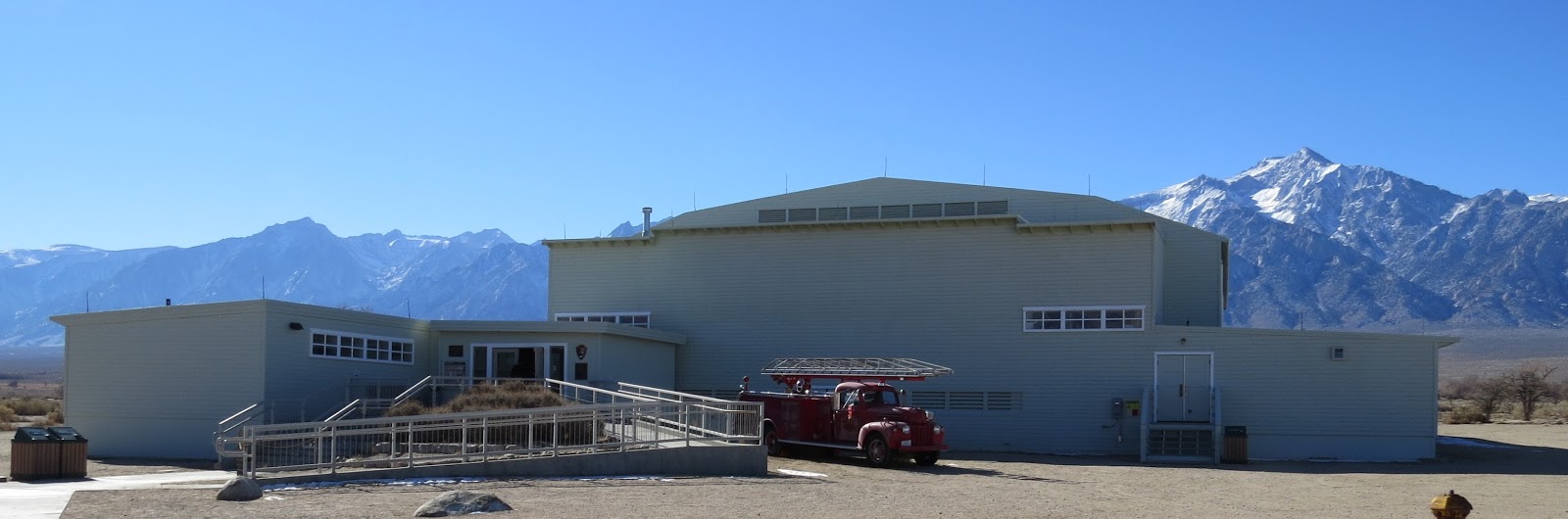
Once an auditorium, the Visitor Center is one of the few original structures remaining.


This scale model of Manzanar’s 3 dozen blockhouses and community buildings hits one over the head with how much it looks like the prison that it was.


A couple of reconstructed blockhouses


provided an excellent representation of what daily living was like with little individual space and no privacy.


How did the inhabitants of Manzanar find the will to construct an elaborate 3-acre Japanese ornamental garden complete with ponds, lovely bridges, flowers, fruit trees, and a gazebo?  This cherished garden of peace and serenity, long buried over the past seven decades under several feet of blowing sand, was just in the early stage of restoration.


Of the 150 who died while imprisoned at Manzanar, only 6 graves remain today.  Most of the deceased were cremated, or their gravesites were relocated by family over the years.


Al and I were moved by all that we read and saw at Manzanar.  One of the most powerful displays in the old gymnasium was the wall with over 10,000 names of those who were imprisoned at Manzanar.  

The question still keeps jumping out at me:  Have we really learned any lessons?


“We had about one week to dispose of what we owned, except what we could pack and carry for our departure by bus… for Manzanar.”  William Hohri