October 26, 2019

EMPTYING THE BUCKET LIST IN WASHINGTON, DC

Carol writes:  Even though we have both been to Washington, DC previously, this time we mutually agreed that it would make most sense to see some of the sights we have never seen before, and so the sightseeing list was formalized...

First, there was that burning desire of mine to visit the White House, or as it is also called, The People’s House.  I soon discovered that White House rules throw all kinds of obstacles in your path, all the while frankly admiting chances of getting a visit approved are not very good.  In a nutshell, you must request tickets for a visit through your member of Congress, preferably 3-4 months in advance.  Even then, you will not be notified if you have scored the coveted tickets until approximately two weeks before your requested dates.  Let’s just say, our South Dakota representative (we are legal South Dakota residents) didn’t let us down!

We showed up bright and early on the assigned date at the proper portal to the White House.  


Reflecting the character of the times, security was pervasive, unyielding, and serious.  No purses or backpacks were allowed on the tour.  I observed a group of four who were forced to abandon their much-anticipated tour because all the women had purses but, sadly, no place to leave them…  


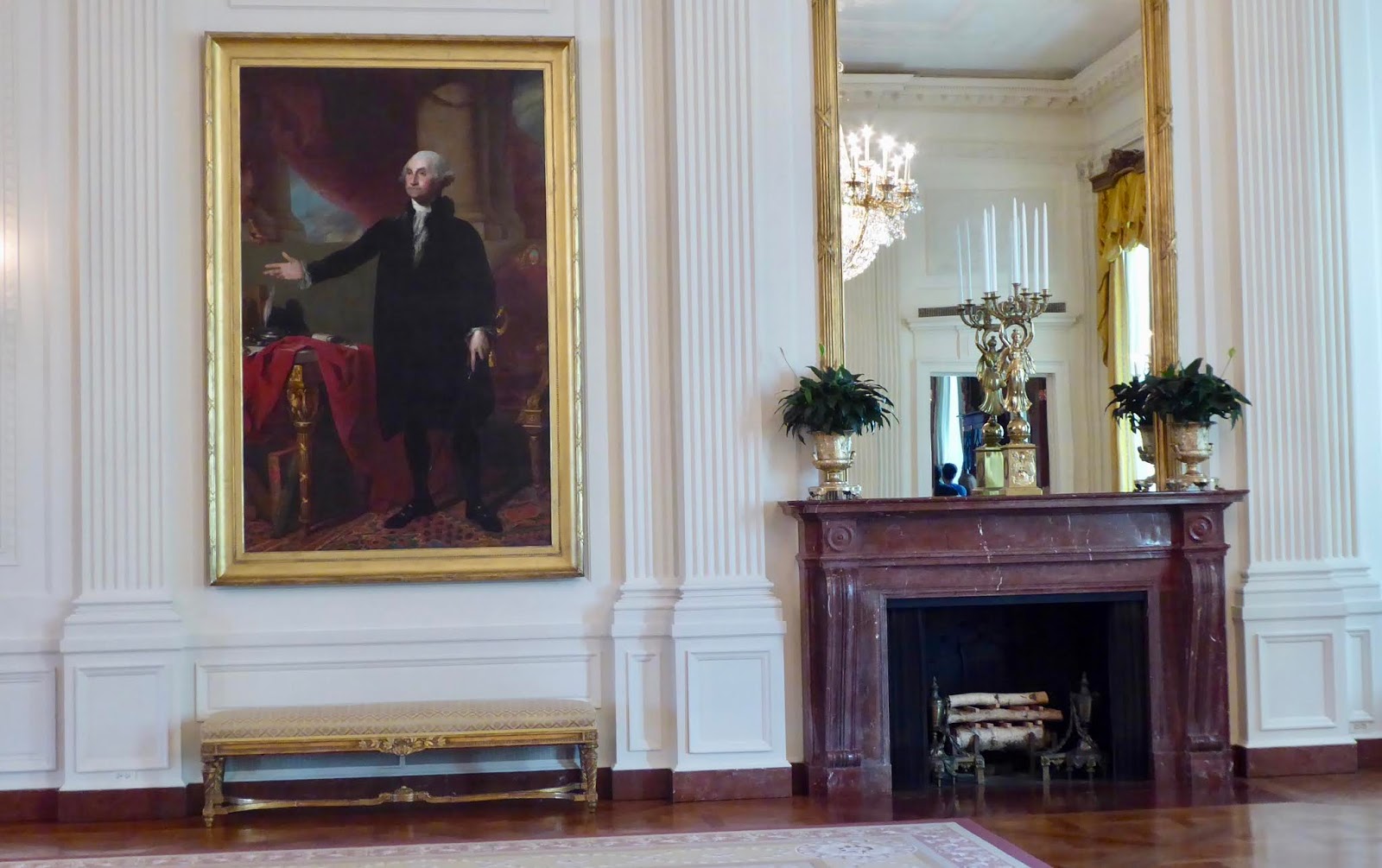
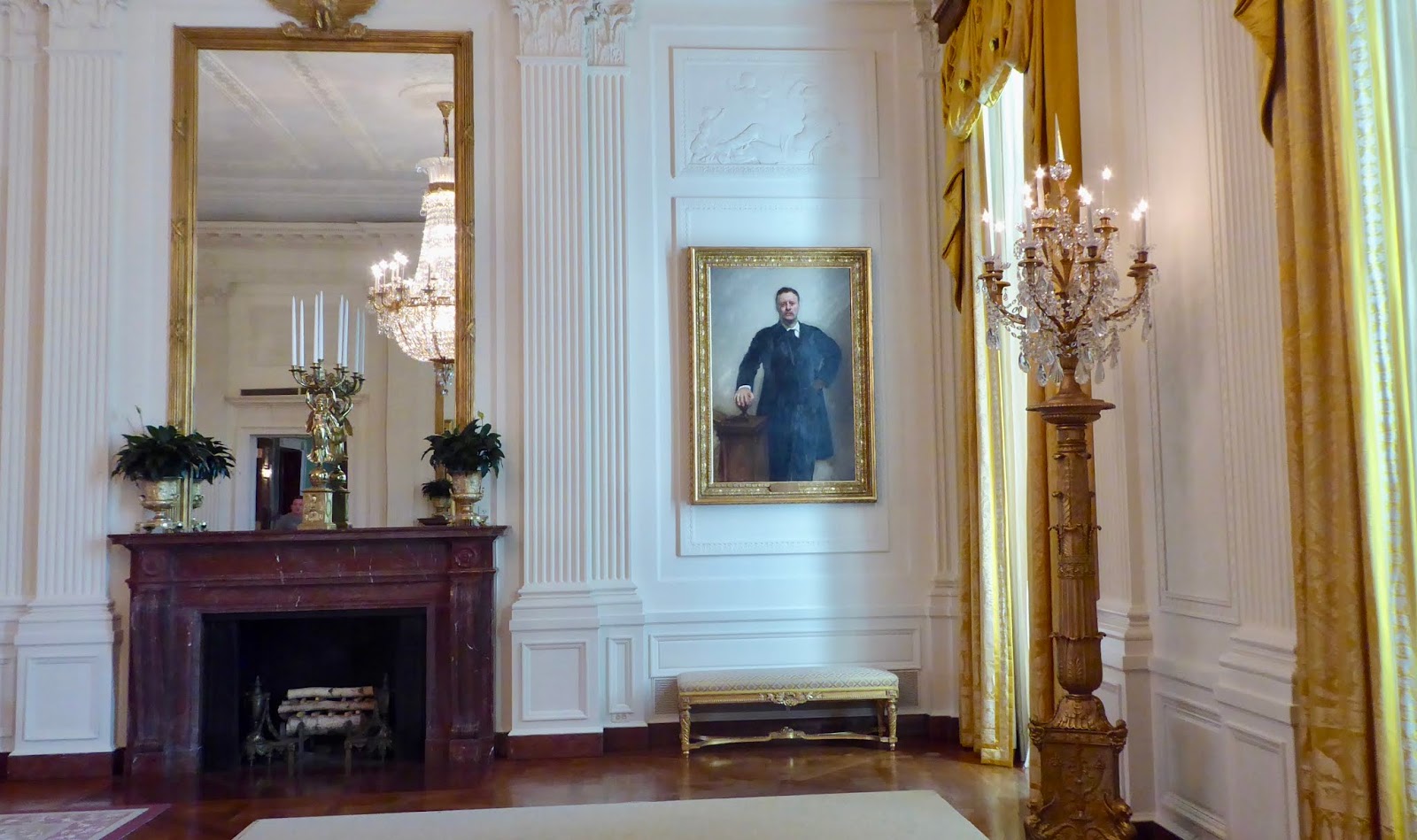
To be perfectly honest, The People’s House looked a little worn, as in this photo of the East  Room.


The items of interest to me in the East Room were portraits of two former presidents—the priceless one of George Washington that Dolly Madison rescued just before the White House went up in flames in 1814, 

and the one of Theodore Roosevelt that was painted by renowned artist John Singer Sargent.

I was expecting a little more glamour in the State Dining Room.


On TV, I have seen it decked out to the nines for formal dinners, but on this day it was in tourist mode setting...

The loveliest rooms in the White House were the rooms named for their color scheme:

The Red Room
The Green Room
The Blue Room
Al thought the most interesting part of the tour was the collection of presidential portraits that hung throughout. 

President Kennedy
President Reagan


The White House library and theater room were mildly interesting.

The White House Library

The White House Theater Room


At the conclusion of the White House tour, getting a selfie at the door seemed the popular thing to do, so that is what we did…


We devoted one entire day to visiting two of Washington, DC’s most famous houses of worship:

the Episcopalian Washington National Cathedral


and the Catholic Basilica of the National Shrine of the Immaculate Conception.


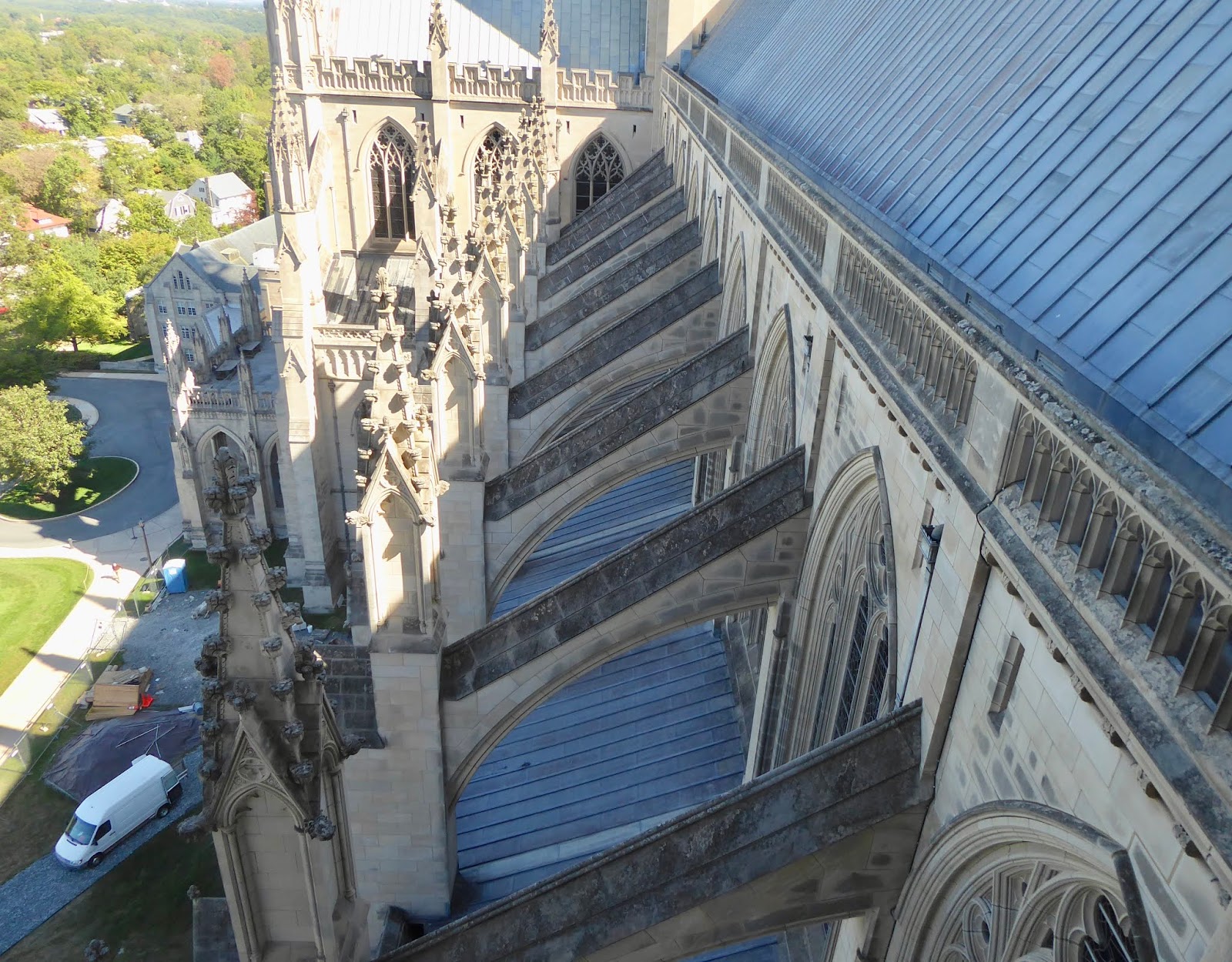
The National Cathedral was a Gothic beauty with classic flying buttresses on the outside that  supported its soaring walls and roof.

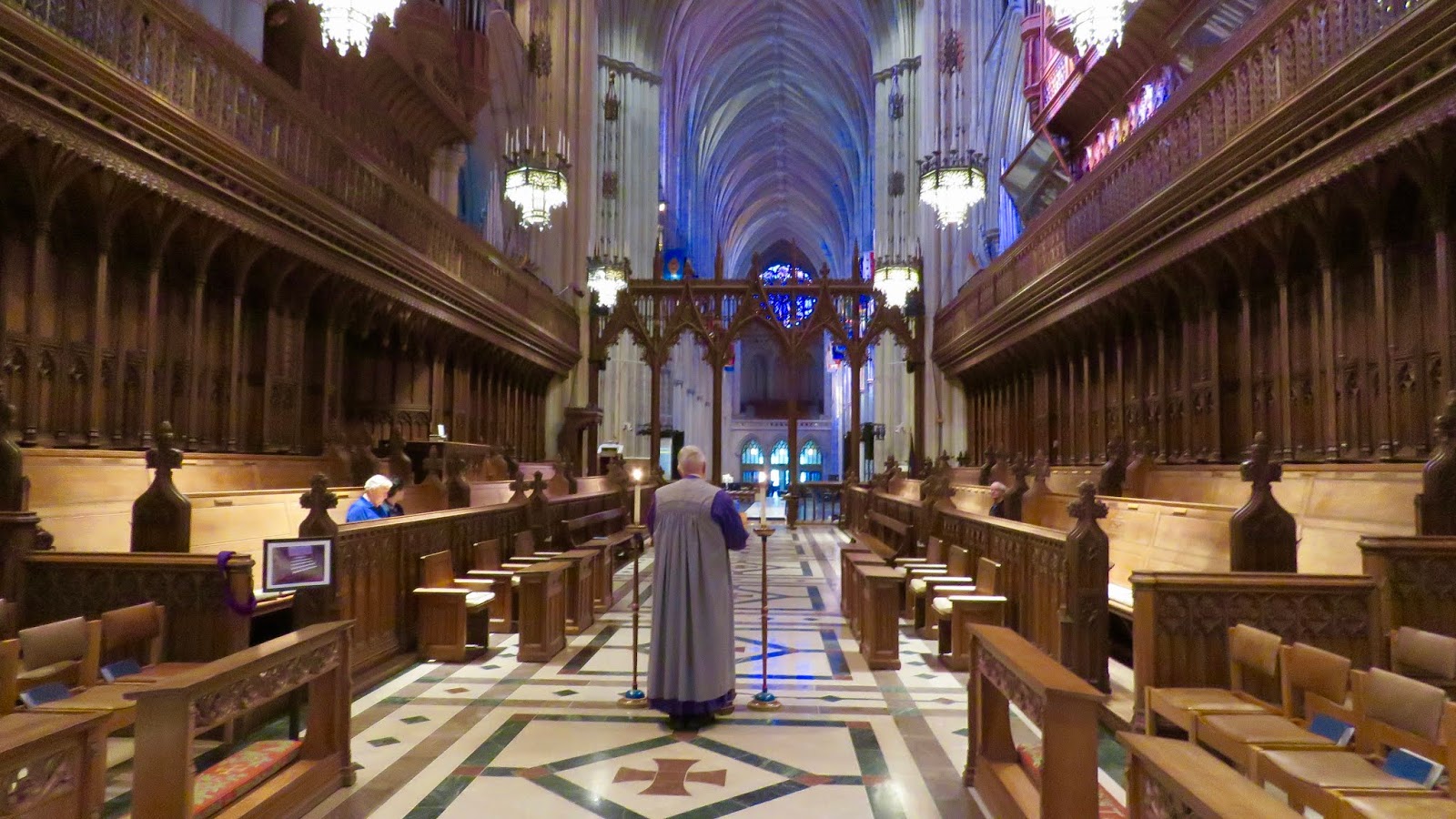
Inside, the noon Eucharist service was just about to begin behind the choir screen.
  
Unknown to us previously, we came across President Woodrow Wilson’s burial tomb in a side aisle.  The most modest presidential burial site we have ever seen…

Tomb of President Woodrow Wilson in the National Cathedral

The Shrine of the Immaculate Conception has laid claim to being the third largest church in the United States and North America.  Clearly, devotion to the Blessed Virgin Mary was the theme.  Countless dazzling multicultural chapels dedicated to Mary occupied niches everywhere.


The main body of the church was immense, with a controversial dazzling mosaic of Jesus Christ in the dome area above the main altar.  The story we heard is that people either think this depiction of Christ is great, or not so great. 


On a day devoted to a walking tour of Washington, we unexpectedly found ourselves across from the Trump International Hotel.   We had to satisfy our curiosity, and so we popped inside.  Staff couldn’t have been nicer to us!  


The bar atrium definitely had a wow factor.  The TV over the bar was tuned to Fox News, and the hotel’s namesake was on the screen…


Comfy chairs in the hall across from a set of gold elevators (of course!) beckoned to us for a few minutes of rest.


A wonderful 360-degree view of the greater Washington area could be appreciated on the top floor of the Clock Tower of Trump International Hotel.


From on high, this was a great view of the Capitol!

For convenience sake, we decided to take advantage of one of the perks offered by our campground.  We signed up for a daytime bus tour that would take us on a Potomac water taxi ride all the way up to Georgetown, then down to Arlington National Cemetery by bus in time for the changing of the guard at the Tomb of the Unknown Soldier.  

The taxi ride along the Potomac gave us a perspective that was out of the ordinary, like these of the Watergate Complex


and the Kennedy Center.


The changing of the guard at the Tomb of the Unknown Soldier 


was a solemn, flawlessly executed ceremony like no other.  The very large crowd was totally stilled and hushed.  The only sound that could be heard was the click of cameras.


As the wife of a Navy veteran and mother of two children who both chose the military as their career, I was emotionally moved at the unwavering devotion to duty shown by the guardians of the tomb as they perform their sacred duty every hour, every day of the year, rain or shine…

The Arlington grounds were lovely on this cloudy day in early fall.


The eternal flame burned bright at the Kennedy gravesite.  I found it poignant to learn that Jacqueline Kennedy was the one who decided that President Kennedy would have an eternal flame burning at his gravesite when she recalled that her husband had admired the one at Gettysburg on his visit there 8 months prior to his assassination. 


For a long time, the National Air and Space Museum complex near Washington Dulles International Airport has been on Al’s bucket list.  This museum had quite an impressive collection of historically significant aircraft and spacecraft.  The highlights of the collection were the Space Shuttle Discovery;


the B-29 Superfortress Enola Gay, the plane that dropped the atomic bomb on Hiroshima;


a Concorde, the first supersonic airliner;


my favorite—the SR-71 Blackbird, the world’s fastest jet-propelled aircraft;


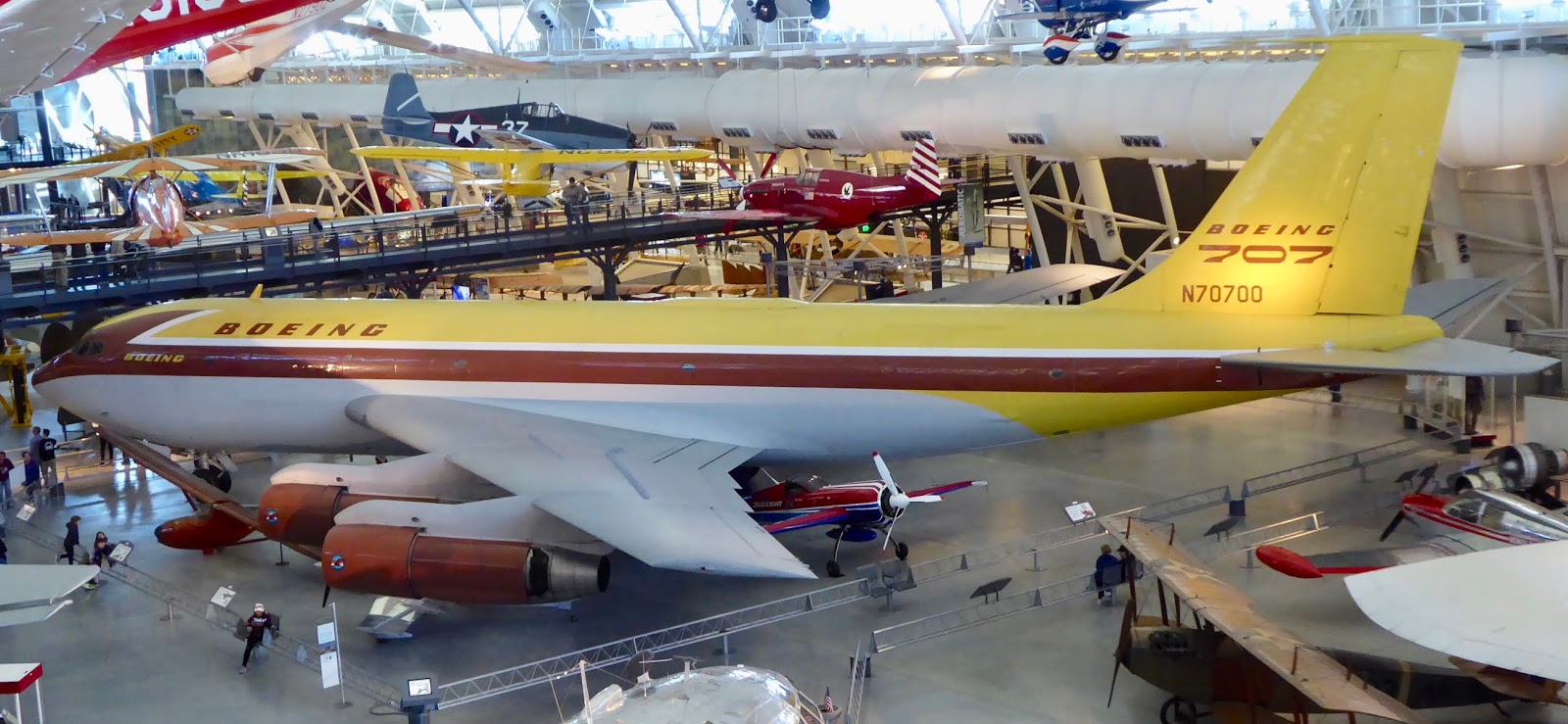
and the Boeing “Dash-80”— the precursor to the KC-135 tanker, a plane my daughter once piloted.

And finally, completing my Washington bucket list was a visit to the Supreme Court of the United States.

On the way we detoured into historic Union Station for a look-see.


Washington, DC is awash in superb architecture on a grand scale.  Many people would agree that the Supreme Court building is the most beautiful of all.


The architectural style is that of a Greek temple intended to convey the absolute sanctity of the law.  The brilliant whiteness and impeccable cleanliness of the marble on the exterior certainly conveys a sense that what takes place here is of utmost importance to our nation.  

In the courtroom, we were treated to a 30-minute docent lecture that told us everything we ever wanted to know about how a case progresses to the Supreme Court.  No cameras were allowed in the courtroom, but afterwards we were able to get a zoom shot between the curtains.


The docent lecture and the 15-minute film narrated by the Supreme Court justices themselves heavily emphasized their collegiality, openness to persuasion, and commitment to reaching decisions based solely on the law and the Constitution.  However, events of recent years have caused me to question these best of intentions.  The west façade of the Supreme Court building displays the motto EQUAL JUSTICE UNDER LAW.  My fervent wish is that the present court lives up to its promises as advertised.

Once again, Lawrence Ferlinghetti’s poem “Pity the Nation” seemed most apt…

“Pity the nation whose people are sheep, 
and whose shepherds mislead them.”

Carol Galus
Photo-Blogger


October 20, 2019

MONUMENTS AND MEMORIALS FOR THE AGES IN WASHINGTON, D.C.


Carol writes:  As the calendar page flipped over to October, our long and winding road to the mid-Atlantic coast reached its most eastward point in Maryland, just outside of Washington, D.C.  Here, we planned to pause for a month to take in the history and sights while reflecting on the many ways our travels have enriched our understanding of what it means to be an American.  We cannot imagine a more fitting place than our nation’s capital to conclude our nearly 5-year adventure across the highways and back roads of America.
We set up camp in a deluxe campground in College Park, Maryland. 
This campground had its own bus stop from which a dedicated bus made dozens of trips daily to the College Park Metro station.  Once we got our first taste of “insane DC traffic,” the Metro rapid transit system turned out to be the perfect means of travel, since almost every city venue we wanted to visit was reachable by Metro. 
The monuments and memorials of Washington, D.C., are perhaps the city’s most beloved treasures.  The ones dedicated to four of our greatest presidents are among the most famous in the world.  
During our last visit to Washington, D.C., the Washington Monument was covered in scaffolding and was undergoing repairs to cracks that had developed as a result of an earthquake in August 2011.  This time, the stonework of this 500-ft spire dedicated to our first president was gleaming brilliantly in the midday sun.


Now, the Jefferson Memorial was the one covered in scaffolding while complex repairs are being made to its dome.  Under the dome inside, Jefferson’s silent, larger than life-size statue evoked volumes of wisdom. 


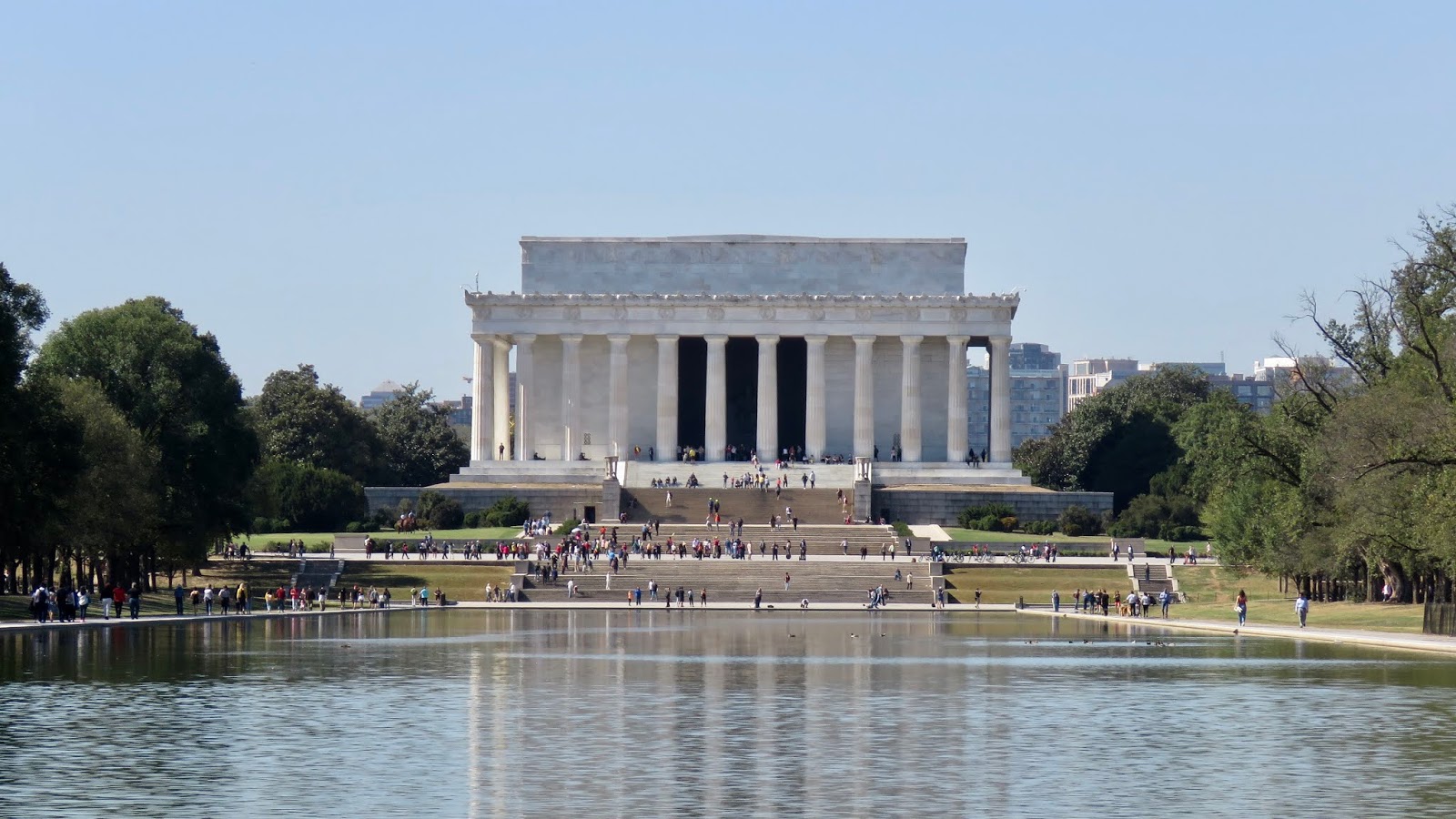
The dignified Lincoln Memorial towered over the western end of the Reflecting Pool on the National Mall. 


The memorial’s 36 grand Doric columns symbolized the states that were in the Union at the time of Lincoln’s death.   

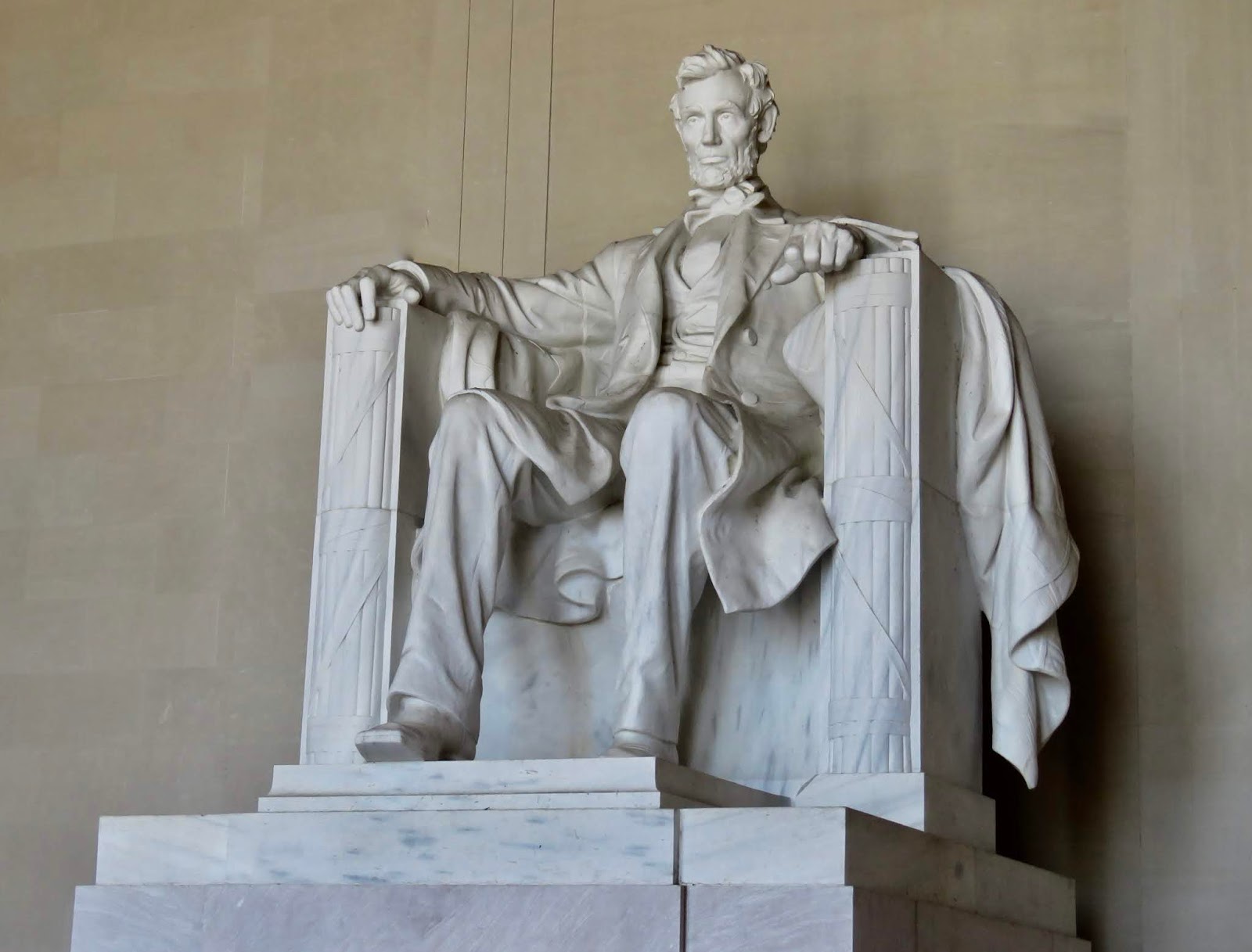
Inside, our beloved 16th president was seated on a grand chair of power and authority, while exhibiting a tense and somber facial expression directed at all the visitors below taking irreverent selfies at his feet.  At this particular memorial, I found the selfie craze distasteful.  In light of our visit to Gettysburg only a few weeks ago, silent thanks and respect seemed much more appropriate.


One of the more unique and less visited memorials in Washington is the Franklin Delano Roosevelt Memorial.  This sprawling memorial consisted of 4 outdoor “rooms” said to represent Roosevelt’s four terms in office.  Shapes of “rooms” were formed by blocks of granite inscribed with memorable FDR quotes.  

The bronze statue of the former president featured a seated Roosevelt along with his beloved dog, Fala.  In this 4th term “room,” the president’s face was clearly exhausted and he appeared to be in poor health.    
It was only fitting that a statue of his wife, Eleanor, 

was included in the memorial to honor her much admired service to our country.
The greatness of America was clearly illustrated at every turn along the Mall.  Likewise, the long redress of America’s greatest failing—enslavement of its African American population—was brilliantly acknowledged at the Martin Luther King, Jr. Memorial.  The “out of the mountain of despair, a stone of hope” symbolism from Dr. King’s famous “I have a dream” speech was a bold design.  

The pathway chiseled through the stone mountain to the rear of the statue was symbolic of the difficult struggles in the fight for equal rights, opportunity, and justice.


This memorial was an excellent place to reflect on both the good and the bad chapters in the American story.  The immense stone statue of Dr. King emerging from a granite block of stone overlooked the Tidal Basin cherry trees that should be in bloom every year on the anniversary of his death.

The war memorials along the National Mall are among the most somber remembrances.  The Vietnam War is still fresh in the minds of baby boomers, and many of them have family and friends who made the supreme sacrifice.  The black granite Vietnam Wall, set into a low hillside and carved with the names of all who perished or are missing in action, represents a superb interpretation of that war.

The diverse group of three young soldiers on patrol, looking on in tribute toward the names on the wall in the distance, emphasizes the poignancy of the sacrifice…

The platoon on patrol at the Korean War Veterans Memorial captured the unspeakable torment of this conflict perfectly.

The newest monument on the Mall, the World War II Memorial, opened in 2004.  This memorial is dedicated to all who served in the armed forces and as civilians in World War II.  The design of the memorial comprises a semicircle of 56 pillars, one for each state and US possession that served in the war.  Triumphal arches for the  Pacific and Atlantic theaters of war anchor opposite ends with sensational fountains in the middle, with waters glistening under brilliant blue skies.

Monuments dedicated to three branches of our military were especially emotional for us.  At the United States Air Force Memorial, our hearts swelled with pride with thoughts of our daughter in the Air Force, who is currently in service to our country.


Three giant steel spires appeared to soar into the sky, representing contrails from the familiar “bomb burst” maneuver performed by the Thunderbirds, the demonstration precision flying team of the Air Force.  Over many years we observed this Thunderbird maneuver on Air Force Academy graduation day at our former home in Colorado Springs.
The bronze statues of the Air Force Honor Guard stood unmoving and silent with honor and respect for all who serve or have served in the United States Air Force.


The Iwo Jima Memorial is dedicated to all Marine personnel who have died in service to our country.  This mammoth bronze sculpture group depicts the moment a large flag was raised on Mount Suribachi during the Battle of Iwo Jima.
The action and drama of the moment is quite inspirational…
And finally, the statue of The Lone Sailor has obvious special significance for the Galus family.  Al served 20 years as an officer in the Navy after graduating from the United States Naval Academy in 1969, and we have come to the Washington, D.C. area to attend his 50th class reunion this week.

The statue of The Lone Sailor also reminds us of this picture of our son, Jason, which was taken in 2004 when he was serving as an Army officer and came to Washington, D.C., to run a race as a member of the Army team.  He is standing next to The Lone Sailor, much like his father above. 

He had a friend take the picture because he knew how much it would mean to his dad.  The sweetness of his message at the side of The Lone Sailor will always mean the world to both of us… 
For now... here are my thoughts on looking back, with lines interspersed from the poem “Pity the Nation” written by Lawrence Ferlinghetti..
The monuments and memorials of Washington, D.C., have reinforced many lessons we have learned at all the presidential sites we have visited throughout our travels.  So many of our presidents were great spotlights in history who shined brightest when our nation needed them most, sometimes while serving as president and in other instances post presidency.  Almost every president (with a few notable exceptions) possessed many admirable character traits—truthfulness, inspiring leadership, devotion to country over self, firmly held convictions, and the ability to unite us as a nation.  We discovered that those presidents who have fallen short of these character traits are HELD ACCOUNTABLE IN THE PAGES OF HISTORY.
"Pity the nation whose leaders are liars, whose sages are silenced, and whose bigots haunt the airwaves."

The war memorials along the National Mall hit home the fact that war is an awful chisel to carve out the future.

“Pity the nation—oh, pity the people who allow their rights to erode and their freedoms to be washed away.” 
And personally, we were once again reminded that the monuments to branches of our military will always pull at our heartstrings…


“My country, tears of thee, sweet land of liberty.”

Carol Galus
Photo-Blogger