Carol writes: Our desire to fully experience life on the West Coast filled our days to overflowing during Year 2018 on the road. From Los Angeles to Seattle, we enjoyed the best of West Coast beaches, mountains, and deserts. We maintained a pace that left us satisfied, but by December… a bit weary. I confess that we really looked forward to a January and February winter slow-down in Tucson, where some minor motorhome repairs and Jeep servicing were scheduled, plus miscellaneous medical appointments, reunions with friends, and some major resting up for the final 8-month push on the road.

Tucson LazyDays KOA Resort turned out to be the perfect change-of-pace choice… For starters, the RV repair facility was right next door, making it convenient for us to move our big-rig back and forth for servicing. In addition, there was a variety of campground activities that definitely captured our interest in this very active senior community:

—pickle ball for Al with a
nice circle of friends,

—and zumba and water aerobics for Carol with a friendly group of like-minded ladies.
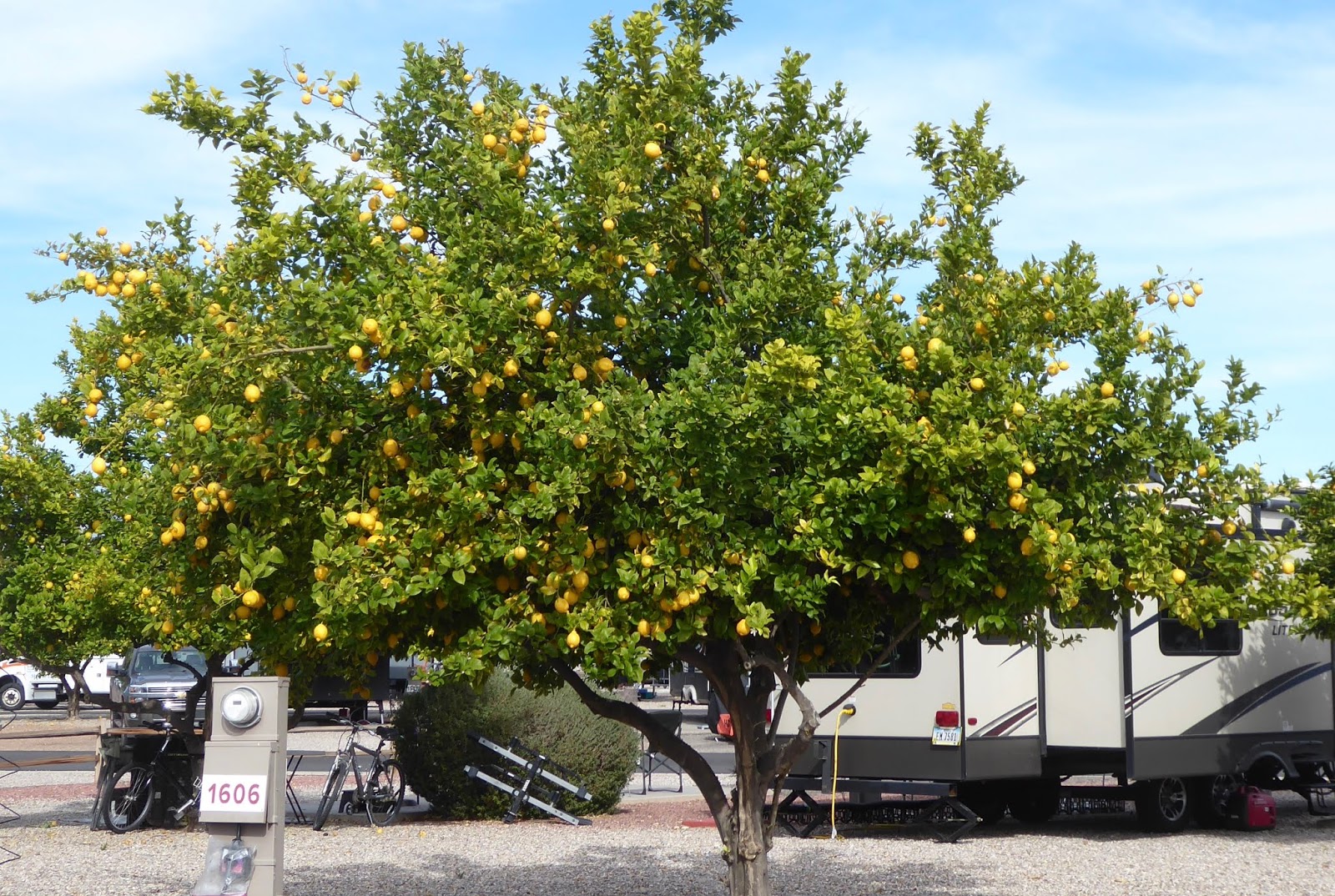
One of the unexpected jewels of this KOA was the profusion of citrus trees along the boundaries of every campsite. As luck would have it, an unlimited supply of oranges, lemons, and grapefruit were ripe and ready for picking when we arrived in the early days of the new year!

Our little orange tree had all the oranges we could eat for the entire 7-week stay! Vitamin C levels were boosted to the max…


Although we had visited Mission San Xavier del Bac on a couple of previous visits to Tucson, we decided to check out progress on the restoration work that had been ongoing for many years at this historic Spanish Catholic mission. The affectionately named White Dove of the Desert has been referred to as the finest example of Spanish Colonial architecture in the United States.
On first sight, the mission appeared even more grand than the last time we saw it…

With the backdrop of an azure blue sky, the Moorish-inspired white stucco exterior appeared reborn. Inside, the main altar was fresh and vibrant in its over-the-top Baroque fussiness.

It was gratifying to see that this treasure of the Tucson area continues to serve the Tohono O’odham Native American community that was its original builders. Thankfully, it would appear that funding is sufficient to ensure that this shining pearl in the desert will be maintained in its historic splendor for a long time to come.

When February rolls around in Tucson, it’s time for the annual world-famous Tucson Gem & Mineral Show. For 2-1/2 weeks, at 47 separate venues all around Tucson, wholesale and retail vendors from countries around the world gathered to showcase their wares. Over 2 weeks, we sampled a few of the largest shows to get a feel for what this extravaganza was all about. We found ourselves fascinated by the spectacle!

By far, my favorite was beads, beads, beads…
I purchased a few strands of my favorite stones with the idea that I would have a few necklaces made for me by an expert. Then I discovered that the actual jewelry making process was relatively simple and required only a few tools. I took a beginner’s class at a local bead shop, and in a few hours I had designed and assembled my very own creation out of the lovely red agates with silver accents that had caught my eye… followed by another out of black onyx and howlite.


I now have a new hobby that requires very little space in the RV…
Our long stay in Tucson gave us some golden opportunities to reconnect with several dear friends. We had dinner at the lovely home of Jared and Katie,


and spent the evening being delightfully entertained by their two adorable children. I’m not exactly sure who was entertained the most!

It had been a long time since I had held such a happy, healthy baby, and this one had a darling disposition!
Thank you, Jared and Katie, for a very special evening!
We also met up for tea with two gals from Tucson that we had met a year and a half ago at a campground in Olathe, Colorado. We quickly became Facebook friends and looked forward to reconnecting with them and their menagerie of pets in their much beloved downtown Tucson home. Linda and Liz, we really get why Tucson is so special to both of you!
And finally, we visited briefly at our campsite with a couple that we knew from our previous home in Colorado Springs. Many years ago, we were introduced to Nolan and Val as the parents of the student aide who assisted Al with his high school math classes when he taught in the public school system. Here’s to meeting up again for some great hiking together when we move closer to your home at our next campground.

There was always one tiny lingering “regret” we had on our last visit to Tucson 6 years ago—and that was missing out on a visit to Kitt Peak National Observatory. This historic observation post has the largest and most diverse gathering of astronomical instruments in the northern hemisphere. From its perch at almost 6900 feet of elevation, the summit of Kitt Peak offers some of the finest night skies in the world.
We arrived in time for a docent-guided tour of some of Kitt Peak’s most well-known telescopes, starting with the historic McMath-Pierce Solar Telescope, the largest solar instrument in the world.


Although this solar telescope is no longer in use, we were able to go inside and look up through the long tunnel toward the aperture to the sky.
More than 20 optical telescopes plus 2 radio telescopes dotted the Kitt Peak landscape. The remnants of a recent snowfall created an immensely beautiful otherworldly effect as seen from this stunning viewpoint on a nearby observation deck.

I freely admit I tend to worry more than I should. If there is nothing worrisome on the immediate horizon in my life, there’s always the Yellowstone supervolcano eruption… or a life-ending large asteroid collision with Earth. So I was hugely reassured when I learned that Kitt Peak is famous for hosting one of the first telescopes dedicated to searching for near-Earth asteroids, then calculating the probability of a collision with Earth. I now sleep better knowing that at Kitt Peak the skies of deep space are closely being monitored for civilization-ending asteroid impacts…
 |
| Earthrise, by Apollo 8 astronaut William Anders |
Needless to say, a day at Kitt Peak made us realize what a TINY place the ‘pale blue dot of Earth’ occupies in the known universe.

Just when we were really into embracing our summery winter in Tucson, Mother Nature played a little prank on us. In late February we could barely believe our ears when we heard that a huge snow event was forecast for Arizona, and that included Tucson! Sure enough, the next day we marveled at the sight of huge snowflakes collecting on citrus trees and cactus around camp!

Because our travel plans over the next month will take us into possible springtime snow country, we have talked about the possibility of a surprise spring snow. We just didn’t think we would be caught this early with snow on the big-rig in Tucson! Nevertheless, I’ll close with my planned meme anyway…
Carol Galus
Photo-Blogger