September 12, 2013

Irish History and Famous Crystal


“When anyone asks me about the Irish character, I say look at the trees.  Maimed, stark and misshapen, but ferociously tenacious.”   Edna O’Brien

Carol writes:  As we continued our drive around the perimeter of Ireland, it seemed like every day we were reminded of the fact that Irish history stretches back thousands of years.  So it was at Newgrange, a fully restored passage tomb at the archeological site called Brú na Bóinne.


Newgrange is a single mound measuring 340 feet in diameter.  It was constructed 5000 years ago and was used as a sacred burial chamber where ceremonies were conducted with the bones and ashes of the dead.  In addition, Newgrange was undoubtedly associated with some sort of Sun God ritual.  As the sun rises on the winter solstice (December 21), it shines through a small window above the entrance door.  As the sun continues to rise, the beam of its light travels down the 60-foot long passageway into the tomb and lights up the small central chamber for 17 minutes.

At Newgrange we were able to enter the tomb by navigating down the narrow 60-foot-long passageway to the sacred central area where our guide turned out the lights and demonstrated by means of a small electric light what it is like on the day of the winter solstice.  The moment was almost spiritual…

As archeologists discover more and more ancient structures that have been found to have some sort of astrological alignment, I find it extremely thought-provoking to get those tantalizing peaks inside the mind of ancient civilizations.

For a little more of Ireland’s more recent history, we visited the Rock of Cashel, one of Ireland’s most historic and noteworthy sights.  Fighting clans fought over this rocky fortification for centuries until a clever clansman decided to donate the site to the Church as a way of keeping it away from a rival clan while at the same time courting favor with powerful religious interests.  Subsequently, Cashel evolved into an ecclesiastical center where majestic stone church buildings were constructed. 


Cashel is dear to Irish hearts because it was the seat of the ancient kings of Munster, one of the five ancient provincial kingdoms of Ireland.  In addition, it was also the place where Ireland’s beloved St. Patrick baptized King Aengus in 450 A.D.  The historic site at Rock of Cashel was a compilation of the ruins of an ancient castle,


Ireland’s first and finest Romanesque chapel,


and the remains of a 13th century Gothic cathedral.


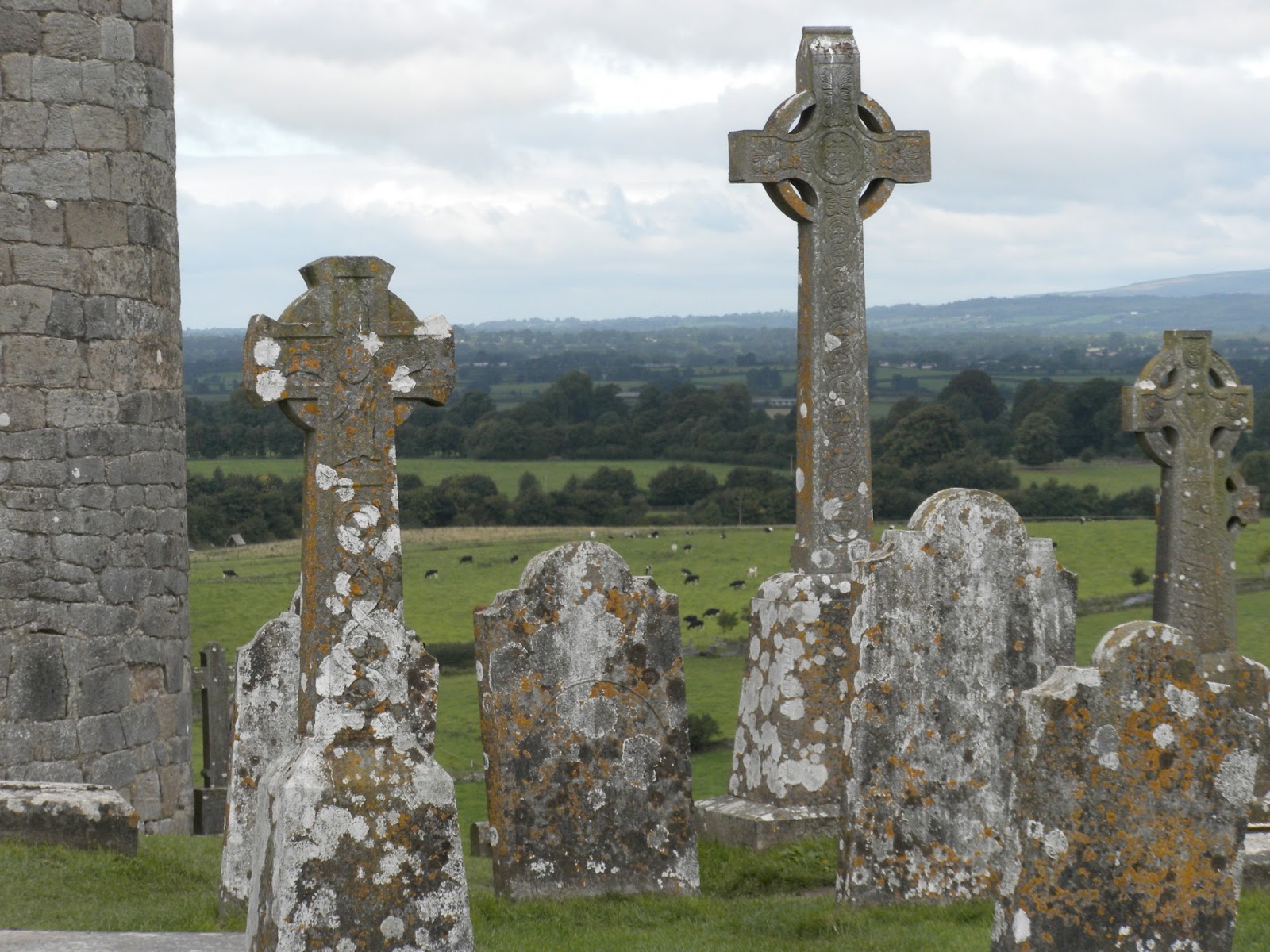
The nearby graveyard was loaded with many Irish high crosses.  Centuries ago, the ring around the head of the cross was added to symbolize the sun in an effort to appeal to the sun-worshipping Celts.

As a nod of respect for the esteem that the Irish hold for the Rock of Cashel, Queen Elizabeth II made a visit to the Rock during her history-making visit to Ireland in 2011.  The Queen and Prince Philip signed their names to some official documents during that visit.  I found the signatures of the Queen and her husband oddly interesting in their simplicity.


As we continued on our drive along the southern coast of Ireland, one of my bucket list items was a visit to the Waterford crystal factory.  Yes, the town is named Waterford too, and apparently the residents of Waterford want it made clear that the town came first and that is where the crystal got its name…not the other way around.   Unfortunately, due to recent bad economic times, most of the high-volume Waterford crystal is now produced by cheap labor in Eastern Europe, and only the special-order one-of-a-kind prestige pieces are manufactured in Waterford. 

As a young bride in 1978, I had flown to Hong Kong to meet up with my husband while he was on a 6-month deployment to the Western Pacific, courtesy of the U.S. Navy.  We had only been married a few months and between the two of us we had very little in the way of household possessions, so we took full advantage of the wonderful bargain shopping available in Hong Kong in those days.  One of our most memorable (and lasting) purchases was 8 precious Waterford crystal goblets, which have always taken center place in our rack of wine glasses.  To this day, I have always admired all things Waterford, so when we heard that their factory tour was first-rate, we made it a point to head to the town of Waterford.

Did the factory live up to expectations?  I cannot speak more highly of the factory tour!  We had excellent vantage points at every stage during the process of producing a Waterford “gem.”  The four-man team doing stemware work was particularly impressive—a marvel of timing and teamwork.


The mold exhibit displayed wooden molds that had been used in the production of dozens of famous sports trophies.  Think college basketball… 

This pic is for my Louisville cousin.

I had a turn at holding a Waterford football…


It was fascinating to see how the intricate design patterns were applied to the final shape with simple black marking pens, and then skillfully ground into the glass with diamond cutting wheels.


At various points along the tour, each of us was offered our own “special-moment photo op” while holding a priceless piece of eye-popping Waterford.


The gift shop at the end of the tour was a wonder to behold with Waterford crystal items of all types for all budgets. 


I loved the large mirror framed with Waterford crystal which was for sale for a price in the neighborhood of $30,000!  Clearly, that wasn’t going home with us, so I took my picture instead.


One of the more interesting facts presented at the very end of the tour was the discussion about the Waterford trademark that is on the edge of the base of their goblets.  The word “Waterford” is engraved in letters about 1/8 inch high, certainly not terribly eye catching, but impossible to miss.  My thoughts did a big “hmmm” when this was mentioned because I was certain (and Al agreed) that my treasured Waterford wine glasses back home in Colorado have no such trademark.  After all, I’ve been washing them by hand for over 35 years, so surely I would have noticed!  I was told I could email a picture of one of my goblets to the Waterford factory and they would tell me if mine are great fake copies or authentic Waterford goblets that were perhaps manufactured before the days of using a trademark.  They were purchased in Hong Kong…could they possibly be fakes?

“I was born on a storm-swept rock and hate the soft growth of sun-baked lands where there is no frost in men's bones.”   Liam O'Flaherty

September 8, 2013

Irish Ring Roads


“Geographically, Ireland is a medium-sized rural island that is slowly but steadily being consumed by sheep.”  Dave Barry, humorist

Carol writes:  In order to understand the above quote, you have to visit Ireland (or the UK, for that matter) and see all the sheep—thousands and thousands of sheep along both sides of every country road!  There must be more sheep than people!  I am still wondering what they do with all those sheep!  It was a relief to find out that the spray paint that is used for identification purposes on the open range is water-soluble and gets washed out of the sheared fleece. Whew!  

Any visit to western Ireland would not be complete without taking in the tourist-favorite ring drive around County Kerry’s Iveragh Peninsula, otherwise known as the Ring of Kerry.  We allotted a full day for the over 100-mile loop drive, hopefully leaving ourselves plenty of time to savor its spectacular scenery along with a sampling of its ancient ring forts. 

We decided to drive the loop in the clockwise direction that was recommended in our Rick Steves guidebook, which is in the opposite direction of the overloaded tourist bus traffic.  That tactic would have worked out brilliantly if only there had not been a daylong bicycle race that was routed around the entire Ring of Kerry in the same clockwise direction!  Roads are very, very narrow in this part of Ireland, so that meant we had to travel at the speed of every bike we encountered until we could find a safe place to pass!

From the very start of our day, the weather didn’t seem like it was going to be in our favor either.  In spite of a steadily worsening dreary drizzle, we were determined to see what we could at our first stop—Staigue Ring Fort.  The sheep didn’t seem to mind the rain in this impressive and desolate setting, so we took it in stride too.


Staigue Fort was built without the use of any kind of mortar or cement sometime between 500 B.C. and 300 A.D.  Measuring about 80 feet in diameter and enclosed by very thick and very high walls, this ancient circular walled structure was used as a place of retreat during times of tribal unrest.  I can’t think of any manmade ruins in the U.S. that even come close to the age of this ring fort.


We didn’t realize it at the time, but this stop at Staigue Ring Fort turned out to be the highlight of our day.  As we continued our drive along the Ring of Kerry, whenever we came to what our guidebook described as a “brilliant view” or a “scenic vista,” all we could see was a fog bank in the distance.  It just wasn’t turning out to be a very ideal day to sightsee along one of Ireland’s most famous scenic drives.  So…that’s all I have to say about the famous Ring of Kerry.

The next day we headed over to the Dingle Peninsula to check out the town of Dingle. Our Rick Steves guidebook claimed Dingle Town was loaded with charm and that it was a great place to take in some traditional Irish pub music.  We had been waiting for that small-town venue where we could park nearby for the night and do our senior version of a “pub crawl,” without having to drive afterwards.  Pub music usually doesn’t start before 9 p.m., so we decided to savor the rest of our brilliant sunny day by taking in the 30-mile Dingle Peninsula ring drive.  We hadn’t gone far before it was obvious this drive would be jam-packed with one gorgeous view after another.


At this viewpoint we chatted with a German couple who were interested in our travels because they had enjoyed a similar adventure 15 years ago when they backpacked around the world! 

This gorgeous windswept Dingle Peninsula has been popular with the movies and was used in the filming of Ryan’s Daughter, starring Robert Mitchum.  We caught a glimpse of the cottage that was used by Tom Cruise and Nicole Kidman when they stayed here (in happier times) during filming of Far and Away.

One of the more interesting stops along the route was at 1300-year-old Gallarus Oratory, one of Ireland’s best preserved early Christian churches.  This simple church was constructed by means of carefully fitted drystone technique and has remained waterproof to this day.


Thus far our travels have shown us that so much of Irish history has been loaded with tragedy, turmoil, and violence.  I discovered a quote attributed to the great Irish poet W.B. Yeats that captured the essence of Irish history when he said, “Being Irish, he had an abiding sense of tragedy, which sustained him through temporary periods of joy.”  Nothing illustrates the tragic history of Ireland more poignantly than the Great Potato Famine (1845-1849).  In four short years, over a million Irish people died of starvation or related diseases when the potato crop, their main food source, was destroyed by a fungus.  The famine years were responsible for the massive numbers of immigrants who left their homes in Ireland for better opportunities in the U.S., Canada, and Australia.  My maternal grandmother’s ancestors were Irish, and I remember my mother telling me that the Great Potato Famine was the reason her distant ancestors moved to America.  Incredibly, abandoned stone huts from the famine years still dot the countryside along the Dingle Peninsula.  Early in our travels in Ireland, along another road, we found several examples of simple stone monuments erected in memory of those who died in the Great Potato Famine.  They have not been forgotten… 


By the time we arrived back in Dingle Town, most of the tourist buses, along with many of the day tourists had already left.  We found a convenient spot in the harbor parking lot where we had been told that although technically not allowed, we could camp for the night and no one would object.  Finally, the stars had aligned for us to check out the ‘trad’ music in the pubs.


Our only mistake was starting our pub crawl in a highly recommended pub called O’Flaherty’s.  Although O’Flaherty’s drinks were superb--a pint of Guiness for Al and a heavenly Bailey’s coffee for me--it took us a while to figure out that the music part wasn’t happening that night at O’Flaherty’s, so we soaked up a wee bit more of O’Flaherty ambience and then headed down the street to another pub where we could hear the guitar music a block away.

I guess when you visit a pub in a tourist town it’s not surprising to find a musician who feels the need to give the crowd what he thinks they want—a few Irish tunes followed by a healthy course of their own music with an Irish twist.  I had hardly finished savoring a meaningful song about the ‘Troubles’ when our guitarist quickly broke out in a John Denver oldie, followed by an Irish version of “Proud Mary.”  Why was this crowd calling for more Johnny Cash after the guitarist’s rendition of “Folsom Prison Blues?”  Oh well, as we sat on the fringe of a large Australian group, Al was enjoying his Guinness and I was starting to mellow from a hot toddy.  In spite of a few puzzling music choices, our guitarist’s lovely Irish tenor voice and not-too-shabby guitar skills made our experience a memorable one.

Before the last call at midnight, we finished up the evening at one more pub located just a stone’s throw away from our ‘campsite’ on the Dingle pier across the street.  Here the music was more of a jam session between a guitarist and another guy with a small accordion.  By that time, I had drunk my quotient of alcohol and was more interested in the nearly 100-year-old framed newspaper articles on the wall that had pictures of the 1916 Easter Day Uprising leaders who were imprisoned and then punished with execution.  What was that all about?  I knew that before we left Ireland we would have to get acquainted with a lot more of its sad and troublesome history.

“Ireland’s ruins are historic emotions surrendered to time.”   Horace Sutton


August 27, 2013

Irish Faith and Iconic Irish Beauty


"That's right, there's free beer in Irish paradise.  Everyone's jealous."   Kevin Hearne, Hammered

Carol writes:  Once I had obtained the medications I needed to get me headed on the road to recovery, we felt confident enough to venture on with our travels into the Republic of Ireland.  I must confess that it was somewhat by accident that we ended up making our first stop for the night in County Mayo in the small town of Knock, which we had only recently learned was the home of Ireland’s major Catholic pilgrimage site.  Since much of Irish history is intricately interwoven with its strongly predominant Catholic faith, we could think of no better introduction to Ireland than a visit to the Shrine of Our Lady of Knock. 

On a rainy evening in August 1879, fifteen witnesses claim to have had an apparition of the Blessed Virgin Mary, St. Joseph and St. John the Evangelist, along with the figure of a lamb on an altar in front of a large cross (symbolic of the Lamb of God).  According to the story, the witnesses watched the vision for 2 hours in the pouring rain while they recited the Rosary.  This apparition was beautifully represented by a simple but elegant statuary display in the Visitation Chapel.

I was somewhat perplexed as to why I had never heard of this event and why it had never been mentioned at any point throughout my Catholic grade school education, even though the Marian vision at Knock has been recognized and sanctioned as trustworthy by the Catholic Church on two separate occasions.  In fact, in 1979 during Pope John Paul II’s visit to Knock for the shrine’s centennial celebration, the Pope called his visit to the Shrine of Our Lady of Knock the goal of his journey to Ireland.  A large papal pilgrimage cross commemorates this visit.

As we walked around the pilgrimage site, we witnessed the daily afternoon ‘rosary procession’ as it snaked its way from the modern-day basilica to the Apparition Chapel.  Dozens of clergy and thousands of pilgrims took part in reciting the rosary as they marched in procession.  I found it interesting that the last decade of the rosary was recited in Gaelic.


So, it was immediately made apparent to us that Ireland’s Catholic faith is still very much a part of the daily life of its people.

From a more secular point of view, Ireland is also noted for its iconic scenery, and we got a good introduction to the so-called “40 shades of green” seen in the Irish countryside of Connemara and County Mayo, along with the “50 shades of gray” (couldn’t resist…) seen in its ubiquitous stone fences and very old buildings of stone.

Ireland is a very large island sticking way out into the Atlantic Ocean, literally the most western point on the European continent.  Such a location almost guarantees rain showers or mists of some degree on most days.  Our challenge was to try and pick the ‘most favorable’ days for our grand scenic drives.  We thought we had the weather forecast all figured out and had carefully selected the day to drive along ‘The Burren,’ a unique geologic formation of windblown limestone wasteland in County Clare,

and then on down to see the dramatic seaside ‘Cliffs of Moher’ soaring  650 feet above the Atlantic Ocean.  In the past 5 months the weather hasn’t aced us out from doing anything we have wanted to do, but as soon as we arrived at the parking lot of the Cliffs of Moher it was obvious our Irish luck had run out.  Within minutes, all we could see was a fog bank at cliff’s edge, leaving us only to imagine what the famous Cliffs of Moher really looked like.

We have a saying in Colorado that if you don’t like the weather, wait 5 minutes and it will change.  The same sort of principle also seems to operate in Ireland…on some days.  During the half hour or so that we were inside the Visitor’s Center looking at some of the displays, the cloud bank moved inland and we had a miraculous break in visibility.  We headed back out to the cliffs and discovered our luck had taken an Irish turn…

Irish people seem to take the weather as it comes and accept that they will experience lots of rain in their life.  However, the typical tourist eagerly looks forward to any day that is predicted to have very low chances of showers, and we were no exception.  The next day the weather in Killarney was predicted to be mostly sunny, just the opportunity we had been waiting for to do some serious housecleaning and RV sanitizing, along with a sizable load of laundry.  We lucked out…


While we were in Killarney, we took the opportunity to visit Killarney National Park, Ireland’s first national park.  We took a tour of a stately Victorian mansion named Muckross House, the park’s chief tourist attraction,

and afterwards had a very nice stroll in the gardens along trails through groves of magnificent gigantic and exotic trees.

Our first week in Ireland proved to us what any tourist knows:  the weather can greatly add to or detract from any outdoor experience.  Our enjoyment of the next two destinations in our travels would be very weather dependent.  We have planned to do a day’s drive each along two rings of very scenic roads on two prominent peninsulas projecting out into the infamous Atlantic Ocean in westernmost lovely County Kerry—the so-called ‘Ring of Kerry’ drive on the Iveragh Peninsula, and the shorter ring drive at the tip of the smaller Dingle Peninsula.  Would the weather play a factor during either ring drive? 

"There are only two kinds of people in the world, The Irish and those who wish they were."  Anonymous