“A
trip to nostalgia now and then is good for the spirit.” Dan Bartolovic
Carol
writes: The
Marietta College years in the late 1960s were a pivotal time in my life. The decade of the Sixties was a time of great
political unrest, much of it centered around the Vietnam War abroad and civil
rights at home. Students became very
vocal on college campuses, and Marietta was no different. In May 1970, the tragedy at Kent State occurred
only two weeks before my graduation day.

I was looking forward to visiting the campus for
the first time since we had made a very brief stop in 1989 during our yearlong
family trip on the road. At that time,
with two young children in tow, our visit on campus was very short, so my memory was a little fuzzy about the details.
This time around, with more time to linger, I was astounded at the
changes that had taken place over the past 46 years. It was quite noticeable that in recent years a
large building and remodeling bonanza had taken place, such as the

new state-of-the-art Legacy Library

and the Dyson-Baudo Recreation Center.
However, despite the external building boon that
had occurred, inside some of the academic buildings small things were exactly the same
as I remembered them:

the classroom where I had my Microbiology
lectures

and the brown seats in the Biochemistry lecture hall, both of which
hadn’t changed one bit in 46 years!

There was an interesting display case in the
Rickey Science Center that memorialized one of Marietta College’s most famous
graduates—Astronaut Story Musgrave, who was instrumental in repairing the
Hubble Space Telescope as it orbited the Earth.
That incredible story hadn’t even been written when I was there…
I must give enormous credit to Al for his
willingness to go along with me as I revisited academic buildings, such as Hermann Fine Arts Center where I took art and music courses,

old dorms like Elsie Newton Hall where I
excitedly pointed out my freshman corner room where the whole college
experience started…

and stately Marietta Hall, my home for three
years.


From the start of our campus visit, I had hoped to
get the chance to speak to one of the students, so when an enthusiastic young female
student volunteered to answer some
questions my husband and I had been discussing over lunch, I joined right in on
the conversation. As a senior, she had a
very favorable opinion about her first 3 years at Marietta College, and she looked
forward to her upcoming profession as a physician assistant; however, she
seemed sad to admit that this year’s freshman class was the smallest in
history. The most shocking thing she
told me was that the full cost of a single year at Marietta College was now
$47,000! My jaw dropped, then my spirits
sagged too…
Back in the 1960s, through a combination of scholarships, loans, student
work and summer jobs, my blue-collar parents could actually fill in the gaps on the cost of
putting two children through college at the same time; it wasn’t easy, but it
was possible… At today’s prices,
Marietta College wouldn’t even have been an option for me!
As coincidence would have it, the weekend of our
visit coincided with Marietta’s biggest
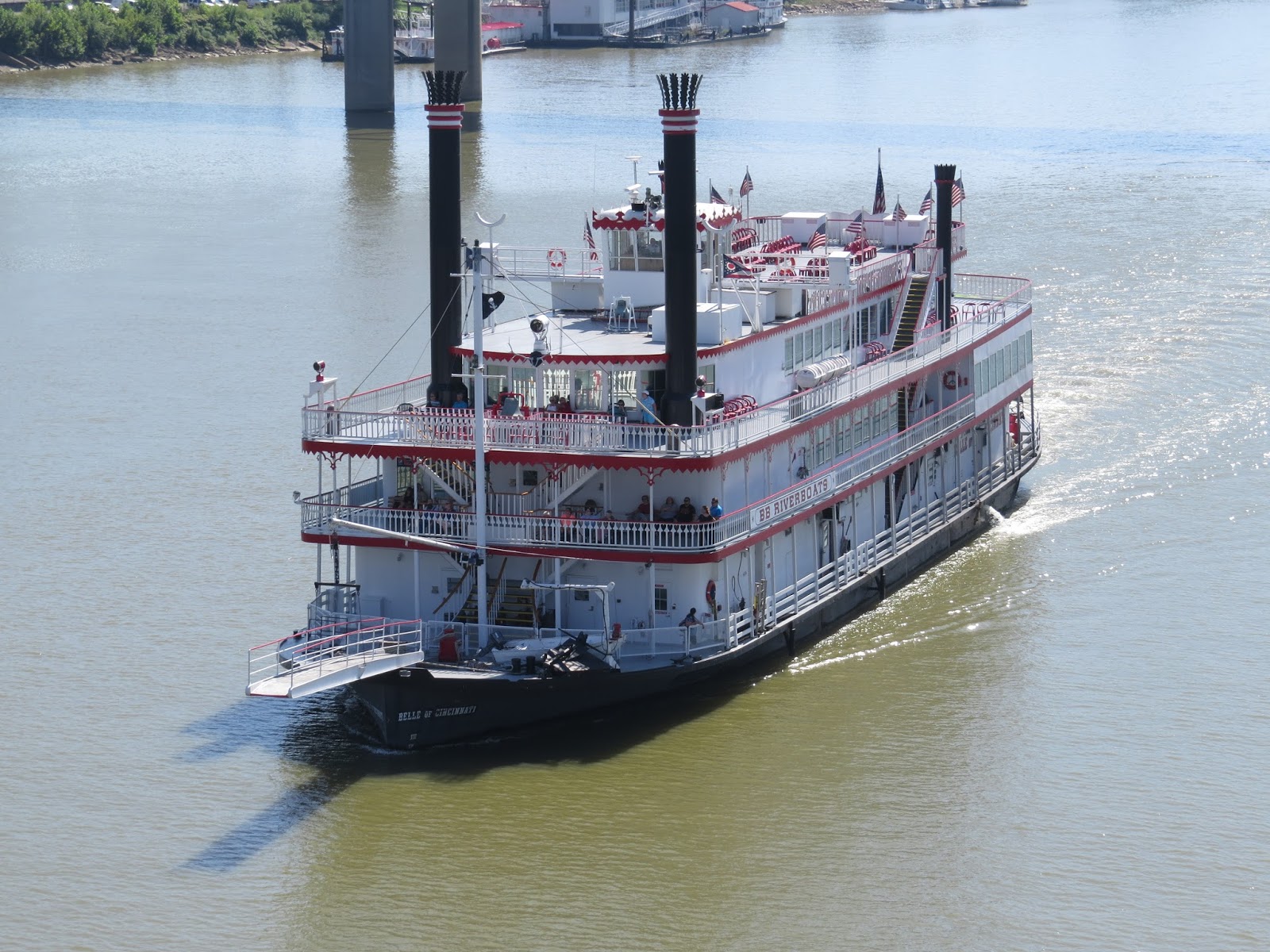
celebration of the year: The Sternwheel
Festival. Marietta is situated at the
confluence of two great rivers—the Ohio and the Muskingum—and so it has a great
riverboat history. With each passing day,
more sternwheelers arrived and tied up along the levee. This made for great picture taking!


Local Republican Party headquarters was right in
the middle of the sternwheel street festivities, so I couldn’t resist a pic...
and apparently I couldn’t totally control my emotions.
While I was a student at Marietta College, the
historic sites that were right under my nose escaped much of my notice. But not this time…

We paid a visit to historic Mound Cemetery and
climbed to the top via a crumbling stone staircase that was almost 200 years
old.


A visit to the Campus Martius Museum explained
that this Conus Mound was built by the Adena Indians sometime between 100 BC
and 500 AD and was part of an ancient earthen works attributed to the Hopewell Native
American Culture whose members lived in the river valleys of central and southern
Ohio. Sadly, the Marietta Earthworks did
not survive subsequent city development.
Fortunately, that was not the fate of some of the ancient mounds, which
served partly as burial sites and likely as ceremonial venues. Instead, in 1803, Marietta’s Conus Mound was
incorporated into what became the city’s cemetery, which has the distinction of
having more burial sites of Revolutionary War officers than any other cemetery in the United
States.

Al was interested to see the gravesite of
Commodore Abraham Whipple, one of the founders of Marietta, in addition to
being considered by many to be the Father of the Navy.
The reason I remembered Mound Cemetery so
vividly was that my roommate and I passed by it every Sunday on our walk to
Mass at “St Mary’s,” now a church with a much longer name since being elevated
to minor basilica status.


Marietta has the distinction of being the first
permanent white settlement in the Northwest Territory. The Campus Martius Museum showcased much of
Marietta’s long history—from the time of the Earthworks pictured in this
painting from 1788,

through the pioneer times of Rufus Putnam, one of the founders of Marietta, a general in the
Revolutionary War, and the Father of the Northwest Territory. Putnam’s original
frontier log cabin, along with a later extension, was remarkably preserved
under roof at the museum.

The interior rooms were furnished with period
antiques.


One of the most interesting sections of the museum
was the bottom floor that was devoted to the large-scale Appalachian Migration that
took place from 1910 to 1970. My mother
and her family were part of this migration from Appalachia to the urban centers
of Ohio. Sometime in the 1930s, Mom’s family moved from West
Virginia to the city of Cincinnati, most likely for better job opportunities. It was fascinating to me to see part of my
family history so clearly on view in this museum display.
How rewarding this Marietta trip back in time was
to me...

With the benefit of hindsight, I have realized that my Marietta days molded my life in so many good ways.
Admittedly, in some minor ways the campus had changed very little, but
in most respects I could see that the college had indeed grown with the times. It did my heart good to see a women’s soccer
team jog off to practice... not many women's teams on campus in my school days, but commonplace now since Title IX. I loved
talking with an eager young woman student who was looking ahead to becoming a
physician assistant, a curriculum that didn’t exist for me in the 60s. And I must mention that we noticed a great deal of cultural diversity throughout the campus.
This past month has proven to me that my Ohio
roots in Cincinnati and Marietta are deep ones.
It has been fun to explore the places where the seeds were planted.
“Life
is here today, gone tomorrow, so sow the right seeds—you’ll be eating from your
own garden.” Barbara Pippins