June 14, 2015

THE FULL MOON AT WHITE SANDS

“Great men are meteors designed to burn so that the earth may be lighted.”  Napoleon Bonaparte

Carol writes:   As we left the cool mountain oasis of Ruidoso and headed downhill to our campground at Holloman Air Force Base in the Tularosa Valley,

the outside temps just kept climbing—all the way to near 100 degrees.  On the outskirts of Holloman AFB, one of the first things we noticed was that the local soil was quite favorable for the growth of pistachios and grapes, for we spotted row upon row of pistachio trees and immaculately maintained vineyards.  We made a mental note to check out both later in the week. 

We had visited White Sands National Monument 25 years ago during our yearlong trip on the road.  All either of us remembered was how much fun the kids had “sledding” down the dunes.  With a few more decades of wear on our bones, this time our visit had a slightly different focus.  We opted to take an evening ranger-led walk out onto the dunes, during which we learned about the unique plant life


and animal life on the dunes,

the geology of how the dunes were created and what makes them so special.  White Sands National Monument is the largest of only three gypsum dune fields in the world.  The sand is very fine, unbelievably white, and ever moving.

Sunset that first night was a special time on the dunes,

and the near-full moon was spectacular.  Al’s camera with up to 50x zoom made for some fun photography of the moon.

Back in Ruidoso, Al had done a quick check on the Internet and had discovered that the full moon would be occurring on the second night in our new location.  He had read that the night of the full moon has become a very special celestial event at White Sands National Monument, and this month the occasion would be celebrated on the dunes with a mariachi band concert that would start just after moonrise.  We were game! 

We arrived early and took an opportunity to enjoy a picnic supper, quickly copying the locals and figuring out how to park to get much needed shade for our picnic table.

A pre-concert photoshoot of the band at the top of a nearby dune must have produced some pretty awesome publicity shots.

Our vanity shots were a little more understated…


As concert time approached, we picked our spot on the dunes.

Shortly after moonrise over the distant Sacramento Mountains, the music began and we were treated to an authentic mariachi band concert in one of the loveliest venues I could imagine.


There was one more experience at White Sands National Monument that we wanted to attempt, and that was an early morning 5-mile hike around the Alkali Flat trail, which led through the heart of the dunes to an ancient lakebed that had occupied much of the Tularosa Basin during the last ice age. 

We had been told to take plenty of water, to start early, and to allow about 3 hours for the hike.  The temperature was ideal at the start of the hike at 7 a.m., and we felt pretty exhilarated.


It didn’t take long before the trail had left all trace of civilization behind.  Incredibly, there we were, all alone on the wildly beautiful dunes, in near-total silence thanks to the area’s restricted air space.


We spotted some animal life in addition to several dune features we had learned about on the ranger-led twilight stroll just a few nights ago—

sand sculptures…

pedestals with plant life…

tracks left behind by dune movement…

and this very cooperative and photogenic nearly white lizard.

Midway, we took a few minutes of rest for a snack and water,


but soon it was time to get moving on.

We would have loved to linger, but our safe 3-hour window was rapidly closing and the temp was rising quickly. Toward the end of the hike, within a matter of minutes, we were VERY aware of the heat; but by that time, fortunately, we had already sighted the parking lot in the distance.

  
We felt this hike ranked near the top of our all-time favorite hikes in terms of both beauty and uniqueness. 

These perfectly undisturbed waves of sand may serve as a seed of inspiration and become an overall quilting pattern in a future quilt project.

One of the local attractions that had caught our attention was the National Solar Observatory, situated at one of the high points in the Sacramento Mountains in a place called Sunspot, New Mexico.  Our friends Barb and Jim had never been to Sunspot and were eager to accompany us on a day trip to visit the observatory, which at 9200 feet is ideally situated far from any major source of air pollution, with plenty of sunshine and dry air.  Scientists from all over the world submit applications for slots of research time on the Dunn Solar Telescope.  Our tour guide informed us that the proposals that are deemed most worthy get the longest time slots on the days of the year with the most sunlight.  Sounds logical…

The tower which houses the Dunn Solar Telescope is 136 feet tall with an additional 228 feet below ground!  Light from the sun enters two mirrors at the top of the tower and is then guided through a vacuum tube to a primary mirror far below ground, then back up into scientific equipment for data collection on optical benches. 

We finished out our special day with our friends with a short stop in western-town touristy Cloudcroft,

then back to “Alamo” for our first taste of Caliches yummy frozen custard, and finally a rematch game of Carbles around our campsite at sunset.

For those of you who are wondering, we did make that visit to one of the pistachio farm/vineyards that we had spotted on the outskirts of town.  We were told at Heart of the Desert Vineyards that New Mexico soil and sunshine are a perfect combination for wine production.  After being offered generous free wine tasting, we were hooked on two samples—one a Pistachio Rosé (yes, a unique pistachio flavor incorporated into a rosé wine!) and a semi-sweet Malvasia Bianca (new to us, but could become a new favorite).  
For good measure, we added in a bag of locally grown pistachio nuts to our purchase.  An awesome happy hour will be coming soon…

Our inaugural week in the desert at Holloman AFB was an enjoyable one.  I got in an afternoon of pool time (one of my weaknesses), and the RV’s air conditioning worked like a champ and kept us cool and comfy.  We loved our daytime and nighttime visits to White Sands and will always remember the stunning majesty of its ever-moving landscape of white dunes.

“I wanna be runnin' when the sand runs out."  
Song by Rascal Flatts  


June 6, 2015

THE OLD AND THE NEW IN RUIDOSO, NM

“We only understand the present when it is past.”  Han Suyin

Carol writes:  We happily accepted an invitation to meet up in Ruidoso, New Mexico, for the Memorial Day weekend with a dear teacher friend and her husband that we know from our Colorado Springs days.  Our campgrounds were only a few miles apart, so we had lots of opportunity to hang out over the weekend with Barb and Jim and the three pups, who now live in Las Cruces.  Since they were familiar with the town and the surrounding points of interest from previous stays in Ruidoso, we were eager for their suggestions. 

We had a patriotic and reflective start to the holiday weekend at the Memorial Day ceremonies at the veterans cemetery at Fort Stanton.  Set spectacularly alone, under a brilliantly blue New Mexico sky with an incredibly peaceful high-desert juniper landscape below, I couldn’t imagine a more appropriate setting for reflection on the sacrifices that were made by our brave men and women in uniform.

Fort Stanton was established in 1855 as a cavalry fort to defend against the Mescalero Apache Indians.  At the turn of the century, due to its ideal dry climate with plenty of fresh air and sunshine, the fort was subsequently turned into a tuberculosis hospital for the Merchant Marine.  Many of the graves in the cemetery are from patients who died of tuberculosis while being treated at Fort Stanton; today, however, tombstones of veterans of other branches can also be found throughout its hallowed grounds.

Some of the old cavalry-days buildings were nicely preserved and made for an interesting trip back in time.
 Try getting 3 dogs and 4 humans all looking at the camera at the same instant…
Both Barb and Jim hail from Minnesota, and so it was that we spent a delightful afternoon at their campsite learning to play a distinctly Minnesota game called “Carbles.”  Why this game doesn’t have more widespread marketing is a mystery to me!  We found it an addicting combination of team play (guys vs. gals) with Cards and Marbles (=Carbles).  The gals are definitely looking forward to a rematch in a few weeks when we move closer to Las Cruces.

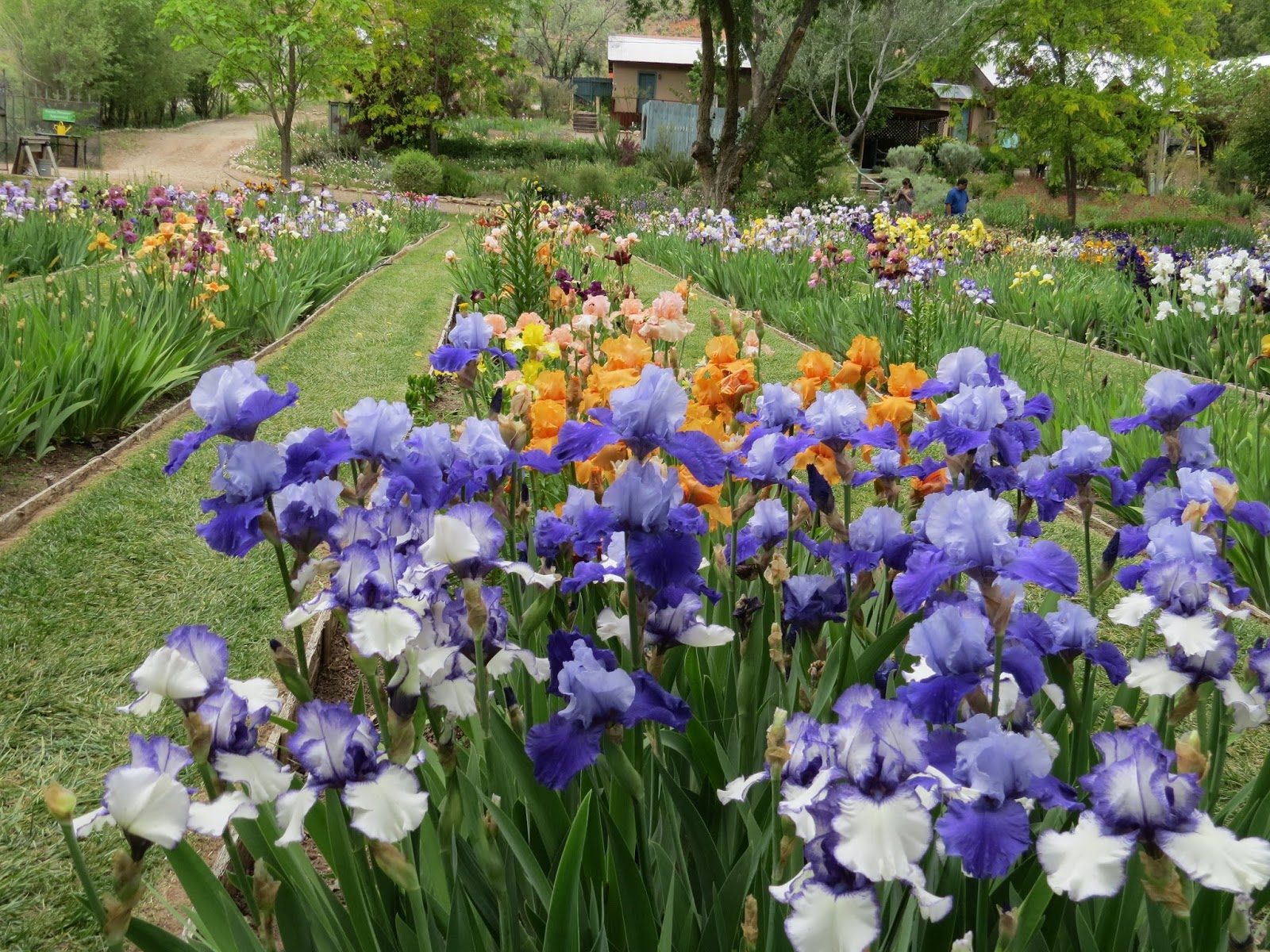
May is iris-blooming time in the mountain elevation of Ruidoso.  The iris were just slightly past their peak the day we took a side trip to a garden oasis at the Hondo Iris Farm.  What is it about large-scale flower displays that instantly lowers the pulse and blood pressure?  I had a fleeting nanosecond of nostalgia over the fact that I no longer have a yard in which to plant bulbs…


The forceful gathering of various Native American tribes onto reservations was not a very proud moment in American history.  The Mescalero Apaches were much feared and were eventually defeated by the cavalry and forced onto a local reservation.  Fast-forward a century and a half, and present-day Apaches have certainly created a way to prosper and grow with a combination of the old and the new.  They own and operate a ski resort named Ski Apache, in addition to one of the most beautifully situated casinos I have ever visited--the Apache-themed “Inn of the Mountain Gods.” 

It looked as if the mountain gods placed it on Earth in a spectacular mountain setting around Mescalero Lake, surrounded by mature pine forests and bare mountain peaks.

We found a reasonable and delicious buffet, and then had a really good time playing ‘friendly’ slots for a couple of hours with the $20 promotional stake offered in the casino.

The Apache artwork was very appealing to the eyes…


The informal family rule is:  If we have spent a day of decadence at a place such as a casino, the next day we try to balance it out by getting back to Nature.

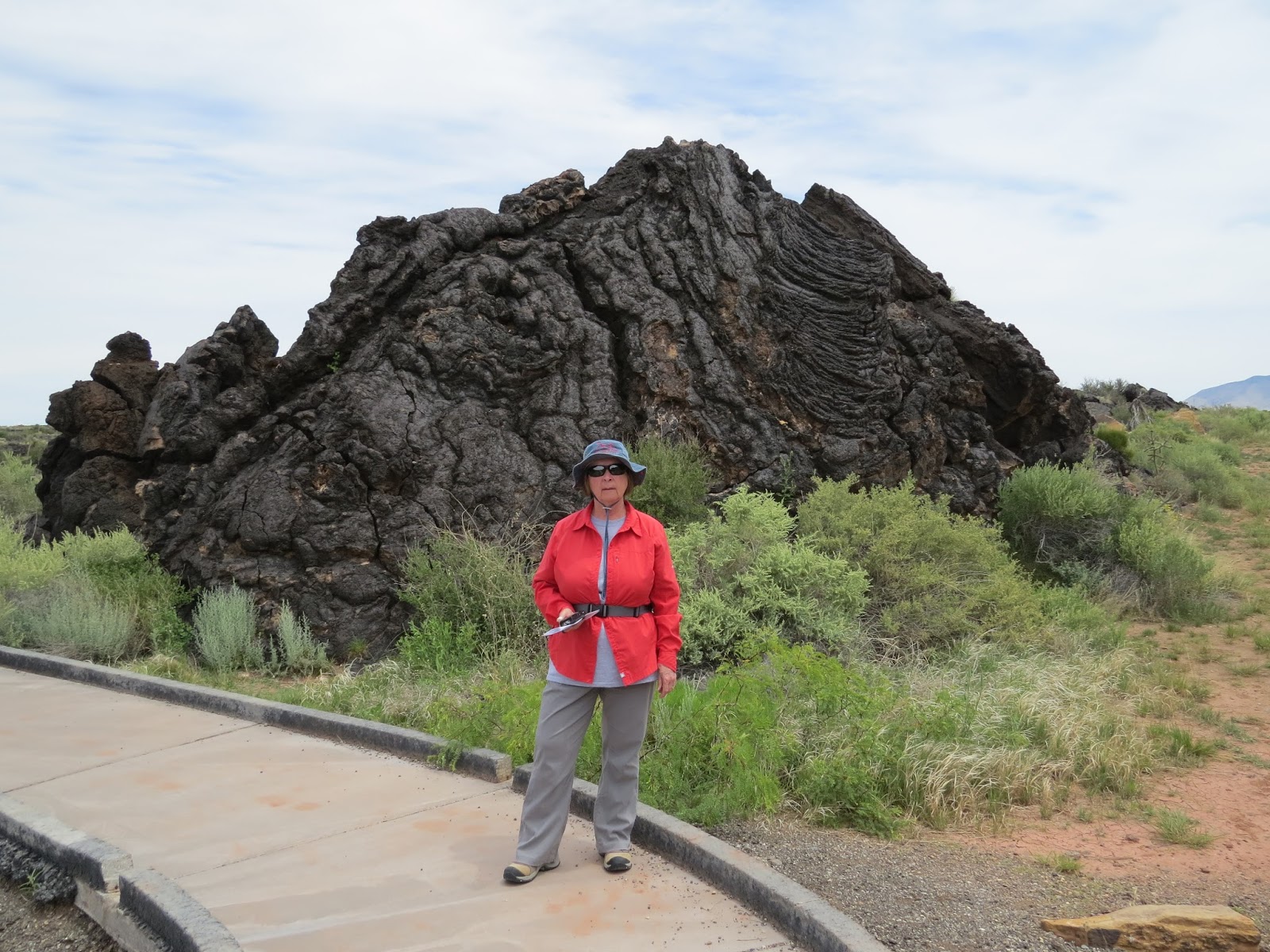
The half-mile hike on the nature trail through the lava beds at the Valley of Fire was quite unique.  This 44-mile long lava flow, which developed from vents in the valley floor 1000 to 1500 years ago, is one of the youngest flows in the continental United States.

The lava itself was both jagged and rippled.

The Chihuahuan  desert plant life that has developed on the lava flow demonstrated the tenacity of life—the blooming prickly pear cactus and stately sotol,


delicate Apache brush,

just-starting-to-bloom cholla,

and an ancient juniper tree that was estimated to be over 400 years old.

During lunch we were entertained by an extended family of towhees feeding their fledgling young.

A visit of any length to Ruidoso would not be complete without a mention of one of the most famous/infamous characters in local cowboy lore—Billy the Kid.  In order to learn a little more about the story of the Lincoln County War and the part played by Billy the Kid, we made a visit to the Billy the Kid Visitor Center, which did a great job of summarizing the pertinent history.  Feeling suitably educated, we were about to leave when the receptionist said we had missed the most photographed part of the museum—in the men’s room!

On the serious and artistic side, the outdoor display of galloping life-size bronze horses was impressive.

From our brief dabble into the life and times of Billy the Kid, we were surprised to find him fondly memorialized in so many ways.  Of course, we had to check out the Billy the Kid Casino on the grounds of Ruidoso Downs Race Track. 

We found Billy’s slots most unfriendly, but what did we expect in a casino named after an outlaw?  We played about an hour on $30 of promotional money and felt lucky to walk out $7.65 ahead.
The Quarter Horse racing at Ruidoso Downs was much more interesting.

One of the races that we watched was won by a lady jockey.  Here is her moment of glory in the winner’s circle. 

I found I got the best pics along the rail.

Then, there was this movie-star-quality guy I spotted in the crowd.

Our stay in Ruidoso was a very pleasant one, made all the more satisfying by getting to share a bit of our lifestyle on the road with dear Colorado friends.  The dry mountain air felt familiar to us, much like Colorado Springs and at about the same altitude (7000 ft) as our former home.  This past week, warm and sunny days were always followed by cool, refreshing nights; but that is about to change…  On Monday we plan to move down 3000 ft in altitude to the desert at Holloman Air Force Base, where we will certainly be testing out our air conditioning for the first time.

"The safest way to double your money is to fold it over once and put it in your pocket."  Kin Hubbard


May 29, 2015

CLOVIS AND THE MAMMOTH HUNTERS

“Everybody talks about the weather but nobody does anything about it.”  Charles Dudley Warner

Carol writes:  As we left Santa Fe, we headed east to Clovis, New Mexico, for a much anticipated visit with our daughter, who had just undergone outpatient knee surgery the previous day.  Over the next few days, it was sort of like slipping back into the very early days of parenting as we helped out with meals and did household chores, all the while hovering close by until we were sure she had smooth sailing climbing stairs on crutches.  That’s what parents are for, right?


Like much of the United States, May turned out to be a rainy month in Clovis, with record rainfalls and extensive local flooding.  Many times during our stay in Clovis we heard that with a change in weather comes illness; sadly, our experience was no different.  First Al got sick, with body aches and a nasty, relentless cough.  Then, Carol had a horrible night of unexplained nausea and vomiting.  Over the next few nights we both had turns testing out sleeping on the living room sofa.  For a while there, the Galus Family was a sorry sight—daughter Megan on crutches, Al unable to get through 5 minutes without coughing, and Carol with sore ribs from ‘giving back’ her meal the previous night! 

Eventually, Al needed to see a doctor.  So--much sooner than expected--we had our first real test of how medical issues could be handled on the road.  Fortunately, Clovis is also home to Cannon Air Force Base and, as a military retiree, Al was able to get an appointment in Family Medicine.  Within 2 hours he had seen a doctor and was fixed up with a handful of prescriptions.  We owe much thanks to the men and women of the 27th Special Operations Medical Group for a job well done.

As you might expect, much of our stay in Clovis was spent recuperating, but we also had time to check out the commissary, health clinic and library facilities on base, plus we had time to enjoy catching up with our daughter by means of conversation and family time during several dinners together.

To be truthful, Clovis really is out in the middle of nowhere--and that is phrasing it kindly.  The nearest decent shopping mall is almost 100 miles away in Lubbock, Texas.  One day, during a break in the rainy weather, the three of us made an all-day excursion to South Plains Mall in Lubbock for a visit to the Apple Store.  We even got “treated” to a Texas-style dust storm on the way home!  I can state that without a doubt this part of the country will not be in the running for the next place we will call home!

By the end of our stay, Megan was crutch-free and driving once again, so Al and I spent one of our last days in Clovis exploring the real reason Clovis has a spot on the map.  Fans of archeology may wonder if that reason has anything to do with a simple but elegant little arrowhead called a Clovis Point.  Well, yes, it does--it was discovered in Clovis, thus acquiring its name.
The tiny but well-explained Blackwater Draw Museum tells the ancient story.

The nearby once spring-fed Pleistocene lake site, with its fascinating trove of ancient tools and animal bones, was a truly revolutionary find in 1929, for it pushed back the archeological clock by more than a millennium to 13,500 years ago as the date of the first human activity in North America.  Archeological artifacts unearthed at the site (and displayed in the museum) have documented that this ancient Clovis culture hunted mammoth and Ice Age bison.  So…while present-day Clovis may not be a very exciting place to live, its place on the map will forever be secure as one of the most fascinating archeological venues of recent times.

We seldom pass up an opportunity to visit a state park if one is in our path because, after all, each park must have some unique feature to justify its creation.  Since Oasis State Park was right next to Blackwater Draw, we dropped in for a visit.  The lake walk was a scenic stroll through some of our favorite desert landscape, with flowers in bloom courtesy of recent rains.  Arty camera pics practically snapped themselves.

The lake shore provided an irresistible backdrop for a selfie of the two of us in our new complimentary, super-nice Spartan Chassis jackets. 


FYI:  Our Entegra RV is on a Spartan chassis.
The state park campground was nicer than we thought it would be.  A brief stroll provided some excitement when this little critter slithered by as we were having a chat with the campground host. Quickly assessing the situation, the campground host recited, "Black touches red, feel no dread; red touches yeller can kill a feller."  I wasn't totally reassured.

As I write this, I can say Al and I are definitely on the mend health-wise, but we would really like to get out from under this prolonged unsettled and rainy weather system.  We have a good friend from Al’s teacher days who plans to spend the Memorial Day weekend in Ruidoso.  Knowing that we have 11 weeks to hang out in the southwest until our August rendezvous in San Antonio, it makes no sense to head east as we had planned.  It looks like we will have one more summer to savor the desert southwest that we love so much.  Heading to Ruidoso, NM to hang out with our friends over the Memorial Day weekend seems like a great plan.
As we round out our two weeks in Clovis, daughter Megan’s medical issue with her knee has not been repaired yet, but the diagnosis has been made and a good plan is in place.  We will meet up with her once again in San Antonio, Texas, in early August, for her definitive knee surgery.  We will be her helpers in San Antonio as she rehabs and recovers, then assist with getting her back to Clovis.  We are so thankful our lifestyle allows us the flexibility to be there when family needs us.

“The family is one of nature’s masterpieces.”  George Santayana